Three days in Paris is enough to fall in love with the city without trying to do everything. It is not enough to see every museum, every neighborhood, every patisserie. But it is enough to understand why people return for a fourth, fifth, tenth time. The trick is to walk a lot, stop often, and accept that you will miss things. Paris rewards slowness. The cafés are designed for it, the parks are designed for it, the river is designed for it.
This itinerary is built around walking neighborhoods rather than ticking off monuments. You will see the Louvre, the Eiffel Tower, Notre-Dame, the Arc de Triomphe, Sacré-Cœur, and Sainte-Chapelle. But you will also sit in a Marais courtyard, eat a galette in a Latin Quarter creperie at 3 PM, watch the sun set from a Seine bridge, and drink a $5 glass of natural wine at a wine bar where locals actually go.
Quick Paris Hotel Search
- Why 3 Days Works (and What You Will Miss)
- Day 1: Île de la Cité, the Louvre, and the Latin Quarter
- Day 2: Eiffel Tower, Le Marais, and the Right Bank
- Day 3: Montmartre, Pigalle, and the 9th Arrondissement
- Where to Stay in Paris: Best Neighborhoods
- Where to Eat in Paris: Beyond the Bistro
- Best Coffee in Paris (the Specialty Coffee Map)
- Getting Around Paris
- What to Know Before You Go
- Common Mistakes First-Time Visitors Make
- Estimated Costs: 3 Days in Paris
- Frequently Asked Questions
- Final Thoughts
Why 3 Days Works (and What You Will Miss)
Paris is dense. Within the Boulevard Périphérique — the ring road that defines the historic city — you have 20 arrondissements packed into 105 square kilometers. That is smaller than San Francisco. Most of the major monuments sit between the 1st and the 8th arrondissements, walkable distance from each other if you have the legs.
Three days lets you cover the essential geography: the islands at the center (Île de la Cité, Île Saint-Louis), the Right Bank with the Louvre and the Marais, the Left Bank with Saint-Germain and the Latin Quarter, the iconic Champs-Élysées axis, and the high ground of Montmartre. You will not get to Versailles unless you sacrifice one of these. You will not see Père Lachaise cemetery, the Catacombs, the Canal Saint-Martin, the Buttes-Chaumont, or Belleville. You will not see the Musée d’Orsay properly. You will not see the Centre Pompidou. Accept this before you arrive.
What three days gives you is the feeling of Paris: the smell of butter and yeast from a boulangerie at 7 AM, the sound of a 75-year-old man playing accordion on the Pont des Arts, the surprise of turning a corner in the 3rd arrondissement and finding a 17th-century mansion you have never heard of. You will start to read the city — Haussmann buildings vs. medieval Marais lanes, Métro lines as a mental map, neighborhoods as personalities.
If you have four or five days, add Versailles (full day), Musée d’Orsay (half day), Père Lachaise (half day), or a day trip to Giverny (Monet’s gardens). If you have only two days, drop Day 3 and split it across Days 1 and 2 — but you will lose Montmartre, which is one of the things people remember longest about Paris.
Day 1: Île de la Cité, the Louvre, and the Latin Quarter
Start at the geographical and spiritual center of Paris: Île de la Cité, the larger of the two Seine islands. This is where Paris began — the Parisii tribe settled here around 250 BC, the Romans built Lutetia here in 52 BC, and Notre-Dame has anchored this island since 1163. You can stand on the parvis (the square in front of the cathedral) and put your foot on Point Zero — the brass star embedded in the stone from which all road distances in France are officially measured.
Morning: Notre-Dame and Sainte-Chapelle (7:30 AM – 11:30 AM)
Arrive at Notre-Dame at 7:30 AM. The cathedral reopened in December 2024 after the 2019 fire — the restoration took five years and roughly 700 million euros. The exterior was always going to survive, but the spire that collapsed during the fire has been rebuilt to Viollet-le-Duc’s original 19th-century design, the wooden roof framework has been recreated from oak forests across France, and the interior has been cleaned to a brightness no one alive had ever seen. Entry is free but you must book a time slot online at notredamedeparis.fr. Lines without a slot are 1-2 hours long even in shoulder season.
Inside, look up. The rose windows on the north and south transepts survived the fire intact — the north rose (built 1250) still shows blue and red light filtering onto the stone. The famous Pietà behind the altar was unharmed. The new altar, designed by Guillaume Bardet in bronze, replaced the previous wooden one that was destroyed. The whole interior feels like a different building from pre-2019 — lighter, cleaner, almost too new in places. Spend 45 minutes to an hour here. Skip the tower climb (currently closed for ongoing work, expected to reopen 2026-2027).
Walk five minutes north on the Île de la Cité to Sainte-Chapelle, the 13th-century royal chapel hidden inside the Palais de Justice complex. From the outside it looks small and almost unremarkable. Inside, the upper chapel is something else entirely — 15 stained-glass windows, each 15 meters tall, surrounding you on three sides. There are 1,113 individual scenes depicted in the glass, telling the biblical story from Genesis to the Apocalypse. Sainte-Chapelle was built in just seven years (1241-1248) by Louis IX (Saint Louis) to house the Crown of Thorns, which he had purchased from the Latin Emperor of Constantinople for more than twice what the chapel itself cost to build.
Tickets are 13 euros and you should pre-book on the official Centre des Monuments Nationaux website. Arrive right at opening (9 AM) to avoid the queue. Visit takes 30-45 minutes — sit on one of the benches for a few minutes and let the color wash over you. On a sunny day the chapel becomes literal stained-glass kaleidoscope.
Lunch: Latin Quarter (12 PM – 1:30 PM)
Cross the Petit Pont to the Left Bank and the Latin Quarter (5th arrondissement). The name comes from the medieval period when this was the university district and Latin was the language of instruction at the Sorbonne. The narrow streets between Rue Saint-Jacques and the Sorbonne still feel medieval — many of the buildings predate Haussmann’s 19th-century rebuilding of Paris.
For lunch, walk to Le Comptoir du Relais (9 Carrefour de l’Odéon) — chef Yves Camdeborde’s bistro that helped launch the entire bistronomy movement in the 1990s. Lunch is à la carte (no reservation needed before 7 PM), simple and excellent: terrine de campagne, steak frites, île flottante for dessert, around 25-32 euros. If it is full, walk three minutes to Polidor (41 Rue Monsieur le Prince) — open since 1845, still serves boeuf bourguignon at communal wooden tables for 16 euros. Hemingway, Joyce, and Verlaine all ate here. The bathrooms are still the original Turkish-style squat toilets. It is not pretentious — it is genuinely unchanged.
Afternoon: The Louvre (2 PM – 6 PM)
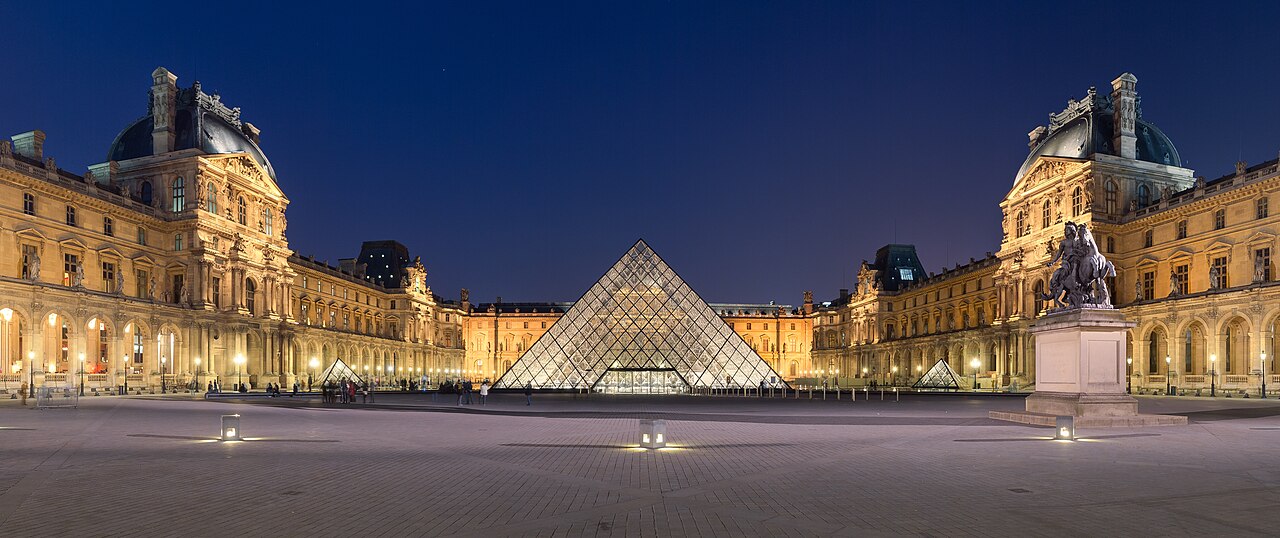
Walk back across the Seine via the Pont des Arts (the pedestrian bridge — beautiful views east toward Île de la Cité). You will arrive at the western edge of the Louvre. The museum is 72,735 square meters of gallery space, holds 35,000 works on display (and 450,000 more in storage), and would take you 100 days to see everything if you spent 30 seconds in front of each piece. You have four hours. Choose.
Enter through the Carrousel du Louvre underground entrance from Rue de Rivoli (line is shorter than the glass pyramid) or pre-book a timed slot for the pyramid. Ticket is 22 euros online (free first Friday of the month after 6 PM, October-March). Take a paper map at the entrance — yes, in 2026, the paper map is still better than the app.
The unavoidable trio: Mona Lisa (Denon Wing, Room 711), Venus de Milo (Sully Wing, Room 346), Winged Victory of Samothrace (Daru Staircase). The Mona Lisa is smaller than you expect (77 × 53 cm), behind bulletproof glass, and surrounded by a permanent crowd 8-10 deep. You will see it for 90 seconds from 5 meters away. This is normal. The painting hanging directly across from her — Veronese’s Wedding at Cana (1563), 6.77 × 9.94 meters — is the largest painting in the museum and gets ignored. Look at both.
Beyond the famous three, prioritize what interests you: French painting in Denon Wing (Delacroix’s Liberty Leading the People, David’s Coronation of Napoleon), Egyptian antiquities in Sully (the Seated Scribe, the Dendera Zodiac), Mesopotamian collection with the Code of Hammurabi (the 4,000-year-old basalt stele engraved with 282 laws), or 17th-century Dutch painting in Richelieu (Vermeer’s The Lacemaker, the most famous Vermeer outside the Mauritshuis).
Pacing tip: set a 90-minute timer. After 90 minutes, sit on a bench for 15 minutes — your feet and your brain need it. The Louvre defeats people who try to plow through it without stopping. Cafés inside the museum: Café Mollien (Denon, second floor, views of the pyramid) for a 6-euro espresso.
Evening: Seine Sunset, Île Saint-Louis, Dinner (6:30 PM – 10 PM)
Exit the Louvre at the Tuileries side and walk through the Jardin des Tuileries as the light goes golden. The garden was designed by André Le Nôtre in 1664 (the same gardener who did Versailles) and runs from the Louvre to Place de la Concorde. Grab a green metal chair (they are free, scattered around the basins) and sit by the round pond for 20 minutes. This is what Parisians do — not the tourists, the actual Parisians who work in the offices nearby.
For sunset (check exact time: 18:00 in November, 21:45 in June), walk east along the Seine to Pont Marie — the 17th-century stone bridge connecting Île Saint-Louis to the Right Bank. It is less crowded than Pont Neuf and gives you a perfect view of the Seine with Notre-Dame visible to the west. Île Saint-Louis itself is residential, expensive, almost village-like, with a single main street (Rue Saint-Louis-en-l’Île) lined with food shops. Stop at Berthillon (29-31 Rue Saint-Louis-en-l’Île) for ice cream — they have been making it on the island since 1954, using only seasonal ingredients (chestnut in November, fraise des bois in June). Two scoops in a cone, 7 euros.
For dinner, you have two directions. Left Bank, walkable: Bistrot Paul Bert (18 Rue Paul Bert, 11th arr.) for classic bistro — duck breast, île flottante, around 50 euros per person with a glass of wine. Reserve a week ahead. Right Bank, more casual: Le Mary Celeste (1 Rue Commines, 3rd arr.) for natural wine and small plates — 60-70 euros for two people with three plates and a bottle. No reservations, arrive at 7 PM or after 9:30 PM.
Walk home along the Seine if you are staying anywhere central. Paris at night, especially along the river, is the city Hemingway wrote about. Bridges lit up, bouquinistes (the green book sellers) closed but their boxes still in place, the occasional bateau-mouche passing with its searchlights. Sleep early. Tomorrow is a longer day.

Day 2: Eiffel Tower, Le Marais, and the Right Bank
Day 2 is the iconic-Paris day. You will see the Eiffel Tower properly, walk the elegant 7th and 8th arrondissements, then descend into the medieval lanes of Le Marais for the afternoon and evening. The contrast between the wide Haussmann boulevards of the morning and the narrow medieval streets of the afternoon is one of the things that makes Paris feel layered.
Morning: Trocadéro, Eiffel Tower, Champ de Mars (7:30 AM – 11 AM)
Take the Métro to Trocadéro (lines 6 or 9) and exit toward the Palais de Chaillot. You will emerge directly onto the Place du Trocadéro, and 100 meters in front of you, across the Seine, the Eiffel Tower will rise out of the morning haze. This is the postcard view, and it works because Trocadéro hill sits 35 meters higher than the Champ de Mars on the other side — you are looking at the tower, not up at it.
Arrive at 7:30 AM. The Trocadéro esplanade is empty, the tower is golden in the side-lit morning light, and the only people around are joggers and a few photographers. By 9 AM there will be 200 tourists, by 11 AM there will be 1,000, and by sunset the esplanade is a crowd-control situation. Spend 20 minutes here — walk down the marble steps toward the Seine, look back at the tower from different angles. The two stone wings of the Palais de Chaillot (built for the 1937 World’s Fair) frame the view.
Walk across the Pont d’Iéna to the base of the Eiffel Tower. The tower opened on March 31, 1889, for the World’s Fair celebrating the centenary of the French Revolution. Engineer Gustave Eiffel won the contract over 700 other proposals. It was supposed to stand for only 20 years — it was kept because the French military discovered it made an excellent radio antenna. 10,100 tons of iron, 18,038 individual pieces, 2.5 million rivets, 324 meters tall. It was the world’s tallest structure for 41 years (until the Chrysler Building in 1930).
You have three options: walk up to the 2nd floor (704 steps, 14.30 euros, takes 30 minutes), elevator to 2nd floor (22.40 euros), or elevator all the way to the top (35.30 euros). The stairs are cheaper, less crowded, and you get a sense of the structure from inside the lattice. The top is dramatic but the view is so far up that landmarks become abstract — you are looking down at a model of Paris rather than at the city itself. The 2nd floor is the best balance: 116 meters up, close enough that you can identify individual streets and buildings.
Pre-book online at toureiffel.paris. Slots disappear weeks in advance in summer. If everything is sold out, the stairs ticket usually has same-day availability — line up at the South Pillar before 9 AM.
After the tower, walk south down the Champ de Mars — the 24-hectare grass park stretching from the Eiffel Tower to the École Militaire. Locals do morning runs here. There is a carousel at the southern end (3 euros for a ride). Buy a coffee and a croissant at the kiosk near École Militaire (4 euros total) and sit on a bench facing the tower. This is the second great Eiffel view — the head-on perspective looking back through the park.
Mid-Morning: Champs-Élysées and Arc de Triomphe (11 AM – 12:30 PM)
Take the Métro from École Militaire (line 8) two stops to Concorde, or walk 25 minutes through the 7th arrondissement (passing the Hotel des Invalides where Napoleon is buried — his sarcophagus sits under the gold dome). At Place de la Concorde, you stand on the largest public square in Paris, 8.6 hectares, designed in 1772. The Egyptian obelisk in the center (3,300 years old, gift from Egypt in 1830) marks the spot where the guillotine stood during the Revolution — 1,119 people were executed here including Louis XVI and Marie Antoinette. The two fountains are 19th century. The eight statues around the perimeter represent eight major French cities.
From Concorde, the Avenue des Champs-Élysées stretches 1.9 kilometers west to the Arc de Triomphe. Walking the full length takes 25-30 minutes. You can do it — it’s pleasant the first half (gardens, Petit Palais and Grand Palais visible to the right) and progressively more commercial in the second half (luxury flagship stores, mid-tier brand shops). Honestly, locals call the Champs-Élysées “the Disneyland of Paris” — the rents have priced out interesting businesses and most cafes there are mediocre and overpriced. Walk the avenue once for the experience, but do not eat there.
The Arc de Triomphe at the far end was commissioned by Napoleon in 1806 to honor the Grande Armée. It was completed in 1836, 30 years and three regimes later. Climbing to the top is 13 euros and worth it for the view down the 12 radiating avenues (one of which is the Champs-Élysées, the others include Avenue Foch and Avenue Wagram). 284 steps, no elevator. The Tomb of the Unknown Soldier sits at the base of the arch under an eternal flame relit every evening at 6:30 PM in a small ceremony.
Lunch: Le Marais (1 PM – 2:30 PM)
Take the Métro from George V (line 1) directly to Saint-Paul (line 1, 7 stops, 18 minutes). You will emerge into Le Marais (3rd and 4th arrondissements), the historic Jewish quarter and one of the few parts of central Paris that escaped Haussmann’s wrecking ball in the 1860s. The streets here are narrow and medieval (Rue des Rosiers, Rue Pavlée, Rue Vieille-du-Temple), the buildings are 16th-17th century hotels particuliers (private mansions), and the neighborhood has reinvented itself as the LGBTQ+ center, the gallery district, and the best place to eat falafel outside the Levant.
For lunch, L’As du Fallafel (34 Rue des Rosiers) is the institution — 8.50 euros for the takeaway pita, which Lenny Kravitz once described in print as the best falafel he has ever eaten. There is always a line. Order at the takeaway window, eat standing or walking. Vegetarian. The alternative is Miznon (22 Rue des Écouffes), the Tel Aviv import — try the whole roasted cauliflower (8 euros) or the bavette-and-onion pita (12 euros). Less famous, equally good, often less of a line.
Afternoon: Place des Vosges, Musee Picasso, Marais Wandering (2:30 PM – 6 PM)
Walk five minutes east to Place des Vosges, the oldest planned square in Paris (1612) and arguably the most beautiful. 36 identical red-brick houses built over arched arcades surround a 140-meter-square garden. The square was the prototype that inspired squares across Europe, including London’s Covent Garden. Victor Hugo lived at No. 6 (now a free museum) from 1832 to 1848. Sit on a bench under the lime trees, watch kids play in the sandbox, read for 30 minutes. The arcades shelter art galleries, a bookshop, and the original location of restaurant Carette for an afternoon coffee or hot chocolate (8 euros).
From Place des Vosges, walk north on Rue de Turenne to the Musée Picasso (5 Rue de Thorigny), housed in the Hôtel Salé — a 1659 mansion built for a salt-tax collector (hence the name, “salty”). 14 euros entry, takes 90 minutes. The museum holds 5,000 works from Picasso’s personal collection, donated to the French state in lieu of inheritance tax. You see his entire arc — Blue Period (1901-1904), Rose Period, African mask influence, Cubism, Neoclassical, Surrealism, late ceramics. Pre-book online to skip queues.
After the museum, just wander Le Marais. Some streets to explore: Rue Vieille-du-Temple (galleries, cafes), Rue de Bretagne (covered market — Marche des Enfants Rouges, open since 1615, oldest covered market in Paris), Rue Charlot (concept stores, design boutiques), Rue des Francs-Bourgeois (the main shopping artery, but try to avoid Saturday afternoon when it is unwalkable).
Stop at Brûlerie de Belleville (10 Rue Pradier — OK, this is technically Belleville, but the Marais branch is at 14 Rue Notre-Dame de Nazareth) for serious specialty coffee (5 euros for a pour-over). Or Boot Café (19 Rue du Pont aux Choux) for the Instagram-famous shoeshine-shop-turned-cafe.
Evening: Aperitif and Dinner (6:30 PM – 10:30 PM)
The aperitif (pre-dinner drink) is a sacred Parisian institution. Between 6 and 8 PM, cafes fill with people drinking wine, beer, or pastis before going home or out to dinner. Find a terrace, order a glass of white wine (5-7 euros), watch the street. Good Marais aperitif spots: Café Charlot (38 Rue de Bretagne, 1930s bistro vibe), Le Mary Celeste (1 Rue Commines, natural wine), La Perle (78 Rue Vieille-du-Temple, classic neighborhood cafe).
For dinner, options in or near the Marais: Robert et Louise (64 Rue Vieille-du-Temple) — côte de boeuf cooked over a wood fire in a tiny 17th-century dining room, 35 euros per person without wine. Breizh Café (109 Rue Vieille-du-Temple) for Breton galettes (savory crepes) with cider, 18-25 euros. Chez Janou (2 Rue Roger Verlomme, behind Place des Vosges) for Provençal cuisine and a famous chocolate mousse served family-style.
After dinner, walk to the Seine for a final view. Pont de la Tournelle on the south side of Île Saint-Louis gives you Notre-Dame illuminated against the night sky. Walk back along the Quai de l’Hôtel de Ville on the Right Bank. Paris at night, late spring through early fall, is one of the great urban experiences in the world.

Day 3: Montmartre, Pigalle, and the 9th Arrondissement
Day 3 leaves central Paris and climbs to the highest point in the city: Montmartre, the village-on-a-hill that was officially absorbed by Paris only in 1860. Until then it was a separate commune with windmills, vineyards, gypsum quarries, and a reputation for cheap wine. The bohemian artist colony came in the 1880s-1900s — Renoir, Toulouse-Lautrec, Picasso, Van Gogh, Modigliani, Utrillo — attracted by low rents, light, and tax-free wine (Montmartre was outside the Paris tax wall until annexation).
Morning: Sacré-Cœur and Montmartre Streets (8 AM – 12 PM)
Take the Métro to Abbesses (line 12) and exit at the surface. The Abbesses station is the deepest in the Paris Métro — 36 meters below street level, with a circular staircase if you skip the elevator. The exit gives you Place des Abbesses, one of the prettiest small squares in Paris, with the green Art Nouveau Métro entrance designed by Hector Guimard (1900), still working and one of only two remaining in Paris.
Walk five minutes north to the Mur des Je T’Aime (Wall of I Love You) in a small park behind Place des Abbesses. The wall is 40 square meters, made of 612 enameled lava tiles, with “I love you” written 311 times in 250 languages. It is a hokey-but-pleasant tourist photo stop. Two minutes.
Now climb. From Abbesses, you take Rue Yvonne Le Tac, Rue des Trois Frères, then up the stepped Rue Foyatier to the foot of Sacré-Cœur. Or take the funicular (a regular Métro ticket works, 2.15 euros, runs every 90 seconds). The climb is 197 steps. Pace yourself, stop at the small terrace halfway, drink water.
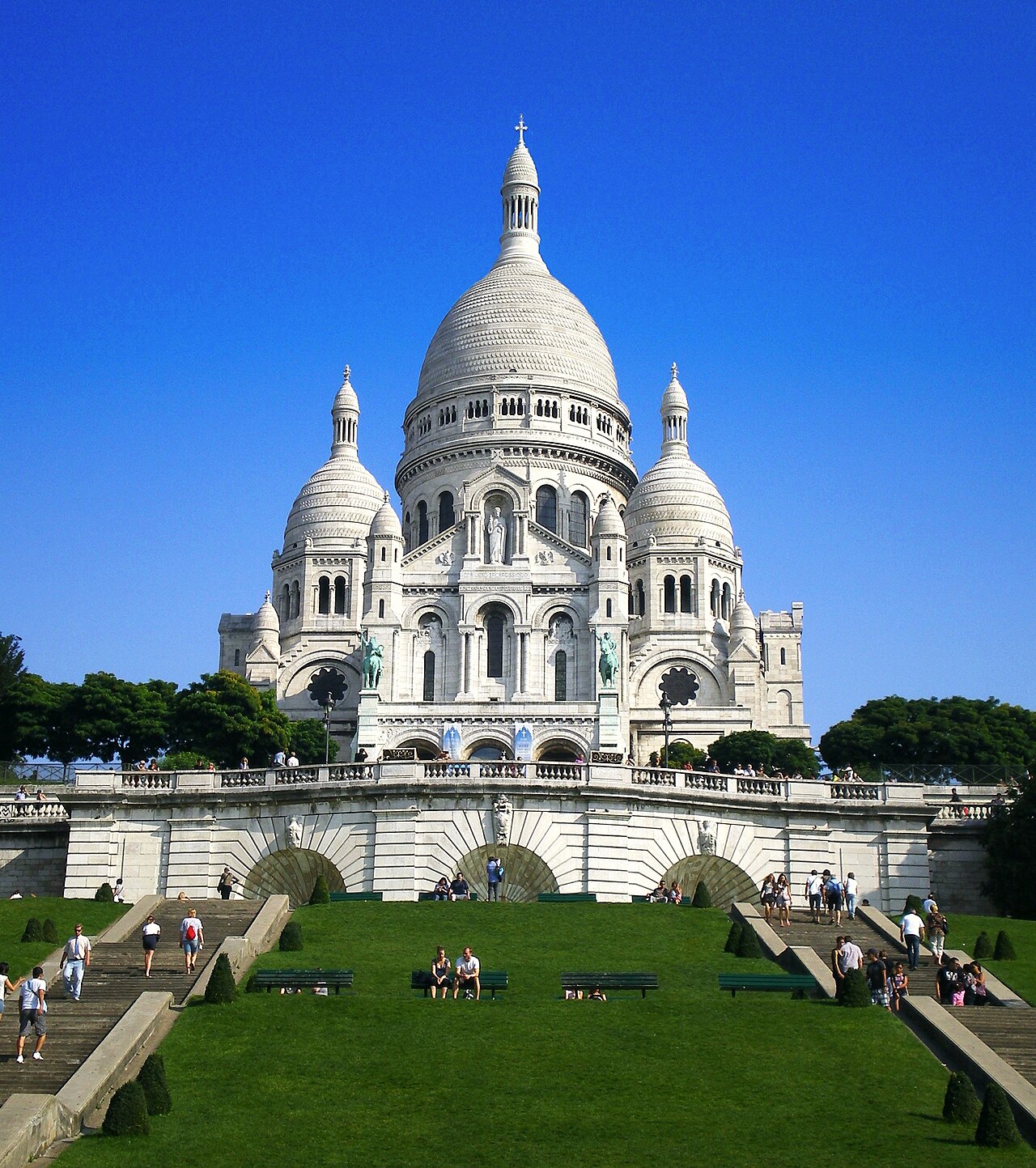
The Basilica of Sacré-Cœur sits at 130 meters above sea level on the summit of Montmartre. Construction began in 1875 as a national act of penance after the disasters of the Franco-Prussian War and the Paris Commune. It was completed in 1914, consecrated in 1919. The travertine stone secretes calcite when it rains, which is why the building stays brilliantly white despite a century of Paris pollution. The interior is dominated by the world’s largest mosaic (475 square meters) showing Christ in Majesty above the apse. Entry to the basilica is free. The dome climb (300 steps, 7 euros) gives you the highest public viewpoint in Paris — 209 meters above the Seine, higher even than the Eiffel Tower’s second floor.
From the basilica steps, the view across Paris stretches 50 kilometers on a clear day. You see the Eiffel Tower to the west, the Pantheon dome on the Left Bank, the towers of La Défense business district in the far west. Sit on the steps for 20 minutes. Locals do not consider Sacré-Cœur an architectural masterpiece (it was controversial when built and remains divisive), but the view is undeniable and the position commands the city in a way nothing else does.
Behind the basilica is the historic village of Montmartre. Walk west to Place du Tertre — the square crammed with cafes and 150 “artists” doing 35-euro portraits in 20 minutes. It is touristy and the art is mediocre, but the square itself (the village commune’s old town square) is genuinely pretty, especially in the early morning before the painters set up. Continue to Rue du Mont-Cenis and the small white Church of Saint-Pierre de Montmartre (1147) — one of the four oldest surviving churches in Paris and almost no one stops in.
Walk west on Rue Norvins to find the Espace Dali (15 euros, mediocre, skip), then descend on Rue Lepic. This is where the real Montmartre starts to appear — narrow lanes, leaning buildings, the Moulin de la Galette windmill (one of two remaining of the 30 that once stood on the hill) immortalized in Renoir’s 1876 painting. The Café des Deux Moulins at 15 Rue Lepic is where Amélie worked in the 2001 film — the cafe still trades on it. Decent coffee, fine omelet.
Lunch: Pigalle (12:30 PM – 2 PM)
Walk down the south slope of Montmartre toward Pigalle, the historic red-light district that has gentrified into one of the more interesting food and drink neighborhoods. The Moulin Rouge cabaret (82 Boulevard de Clichy) still operates — not really worth attending in 2026 unless you specifically want the show ($100+ tickets) — but the building itself with the red windmill is a recognizable landmark.
For lunch in Pigalle: Le Pantruche (3 Rue Victor Massé) for modern French cooking — 25-euro lunch menu, three courses, very good. Buvette (28 Rue Henry Monnier) for casual French-American bistro — think eggs Benedict and croque madame, around 18-22 euros per plate. Or Bouillon Pigalle (22 Boulevard de Clichy), the popular budget option — 6-euro starters, 10-euro mains, no reservations, expect a line.
Afternoon: Galeries Lafayette, Opéra, or Musée d’Orsay (2:30 PM – 6 PM)
You have a choice for the afternoon. Option A: Department stores and Opéra. Walk south to Galeries Lafayette Haussmann (40 Boulevard Haussmann) — the flagship store with the famous Art Nouveau stained-glass dome (built 1912, 43 meters in diameter). Even if you do not shop, take the elevator to the rooftop terrace (free, 7th floor) for a panoramic view of central Paris including the back of Opéra Garnier, the Eiffel Tower, and Sacré-Cœur from a different angle.
Adjacent is the Opéra Garnier (Place de l’Opéra) — the 1875 opera house designed by Charles Garnier. Self-guided tour 16 euros, takes one hour. The Grand Staircase, the Foyer (designed to look like Versailles’ Hall of Mirrors), and the auditorium with the Chagall ceiling are all worth seeing. If a rehearsal is happening you can sometimes hear the orchestra through the doors. Box 5 (the haunted box from The Phantom of the Opera) is real and you can see it from outside the auditorium.
Option B: Musée d’Orsay. Take the Métro to Solferino (line 12) or Musée d’Orsay RER. The Orsay is a former Beaux-Arts railway station (built 1900, closed 1939, converted to museum in 1986) holding the world’s greatest collection of Impressionist and Post-Impressionist painting — Monet, Renoir, Degas, Cézanne, Van Gogh, Gauguin, Toulouse-Lautrec, Manet. 16 euros entry, 2-3 hours. The fifth-floor Impressionist galleries are unmissable. Behind the giant station clock you get a view back over the Seine that no other museum offers.
Option C: Père Lachaise Cemetery. Take the Métro to Père Lachaise (line 2 or 3) for the largest cemetery in central Paris (44 hectares, over a million people buried). The famous graves: Jim Morrison (Division 6), Oscar Wilde (Division 89, his tomb covered in plexiglass to protect it from kisses), Édith Piaf (Division 97), Chopin (Division 11), Proust (Division 85). Free entry, maps at the entrance, 2-3 hours. Closes 5 PM in winter, 6 PM in summer. This is for visitors who specifically want it — it is a beautiful place but it eats a half day.
Evening: Final Dinner and Walk (7 PM – 11 PM)
For your final Paris dinner, splurge or go classic. Classic bistro: Le Bistrot Paul Bert (already mentioned, 18 Rue Paul Bert, 11th arr.) or Chez Georges (1 Rue du Mail, 2nd arr., 1860s decor, classic French menu, 70 euros per person with wine, reservation required two weeks ahead). Modern bistronomy: Septime (80 Rue de Charonne, 11th arr., one of the most-booked restaurants in Paris, 110 euros for the tasting menu, reservation 3 weeks ahead online only) or Clamato (its no-reservation seafood sister at 80 Rue de Charonne next door).
Casual final-night option: Le Servan (32 Rue Saint-Maur, 11th arr.) for confident modern French, 50 euros per person, walk-ins possible at 7 PM. Wine bar with serious food: Le Verre Volé (67 Rue de Lancry, 10th arr., near Canal Saint-Martin) — small plates and an exceptional natural wine list, 50-60 euros per person with two glasses.
After dinner, walk to the Canal Saint-Martin (10th arrondissement) for a final Parisian view. The 4.5-kilometer canal was built by Napoleon between 1802 and 1825 to bring fresh water to Paris. Today, the iron footbridges and tree-lined banks are where younger Parisians sit with bottles of wine on summer evenings. Quai de Valmy and Quai de Jemmapes are the prettiest stretches. This is the modern Paris — not Haussmann’s Paris, not the medieval Marais, not the bourgeois 7th. It is where 25-to-40-year-olds live, eat, and drink right now.
Where to Stay in Paris: Best Neighborhoods
Paris has 20 arrondissements arranged in a spiral starting from the 1st in the center. For three days, stay in the 3rd, 4th, 5th, 6th, or 1st arrondissement — you will be walking distance to most things and the Métro will cover the rest. Avoid hotels in the 8th near the Champs-Élysées (touristy and overpriced), the 9th near Opéra (fine but charmless), or anywhere outside the Boulevard Périphérique unless you really like Airbnb in a suburb.
Find Your Paris Hotel
Compare prices across Booking.com, Expedia, Agoda and more in one search.
Search Paris Hotels →Le Marais (3rd, 4th arr.) – Best All-Around
Le Marais is what most first-time visitors picture when they imagine staying in Paris — narrow medieval streets, 17th-century mansions, cafes spilling onto cobblestones, walking distance to Notre-Dame and the Louvre. The neighborhood is also extremely walkable for nightlife and food.
Cour des Vosges (19 Place des Vosges, 4th arr.) is the luxury option — 12 rooms inside a 17th-century mansion directly on Place des Vosges, with bedroom views of the square’s arcades. From around 650 euros per night in shoulder season. Genuine historic property with modern bathrooms.
Hotel Caron de Beaumarchais (12 Rue Vieille-du-Temple, 4th arr.) is the mid-range choice — a 19 room boutique done up in 18th-century Marais style (toile-de-Jouy wallpaper, period furniture, no minimalism). From 220 euros per night. The location is unbeatable — you are five minutes from the Seine, five minutes from Place des Vosges, ten minutes from Notre-Dame.
Hotel Jeanne d’Arc (3 Rue de Jarente, 4th arr.) is the budget pick — 36 small but charming rooms behind Place du Marché Sainte-Catherine, the prettiest small square in the Marais. From 160 euros. Walls are thin, rooms are small, but the location is exceptional and the staff knows the neighborhood well.
Saint-Germain-des-Prés (6th arr.) – Classic Left Bank
Saint-Germain is the Left Bank’s elegant heart — the literary district where Sartre, de Beauvoir, Camus, and Hemingway drank at Café de Flore and Les Deux Magots in the 1940s and 50s. Today it is upscale and a little touristy on the main boulevard, but the side streets remain genuinely beautiful and the location is perfect for walking to the Louvre, the Latin Quarter, the Musée d’Orsay, and across the river to the Marais.
Hotel L’Hôtel (13 Rue des Beaux-Arts, 6th arr.) is the famous one — Oscar Wilde died here in 1900 in Room 16. The hotel today is small (20 rooms), eclectic (Jacques Garcia decor), and has a Michelin-starred restaurant in the basement. From 500 euros. The Wilde room is bookable and bookable far in advance.
Hotel La Louïsiane (60 Rue de Seine, 6th arr.) for mid-range — above the famous Le Marché de Buci market, family-run since 1925, simple rooms with a sense of place. From 170 euros. Miles Davis stayed here in the 1950s. The rooms have not been overly renovated, which is the point.
Latin Quarter (5th arr.) – Studenty and Walkable
The 5th is the university district, full of young energy, cheap bistros, bookshops including the famous Shakespeare and Company (37 Rue de la Bûcherie), and proximity to Notre-Dame and the Pantheon. It is less polished than the 6th, more democratic in its food scene, and a good neighborhood if you want to feel like you are living somewhere rather than just visiting.
Hotel Monge (55 Rue Monge, 5th arr.) is the standout boutique — 30 rooms, beautifully designed, Roman ruins of the Arenes de Lutèce one block away, the Jardin des Plantes 10 minutes walk. From 240 euros.
Saint-Honoré / Tuileries (1st arr.) – Right on the Louvre
The 1st is the centermost arrondissement, home to the Louvre, the Palais Royal, Place Vendôme, and the Tuileries. It is genuinely the heart of Paris. Hotels here are not cheap, but you wake up and walk to everything.
Hotel du Continent (30 Rue du Mont-Thabor, 1st arr.) is a 25-room boutique hidden on a quiet side street between Rue Saint-Honoré and the Tuileries. Each room is decorated by continent (“Asia,” “Africa,” etc.) — done with restraint rather than cheese. From 250 euros. Concorde Métro is two minutes, the Tuileries garden is at the end of the street.
Where to Eat in Paris: Beyond the Bistro
Paris dining in 2026 is a much wider field than the classic bistro of 1985. There are still bistros doing duck confit and steak frites with the same elegance they always had. There are also natural wine bars, neo-bistros (“bistronomy”), Israeli street food, Japanese izakaya, Senegalese, Vietnamese, North African, and serious specialty coffee. Eat across the spectrum.
Classic Bistros (the unchanged ones)
Le Petit Pontoise (9 Rue de Pontoise, 5th arr.) — small, warm, run by the same family for decades. The signature lamb shoulder with rosemary takes 7 hours to cook and falls apart on the fork. Three-course menu 38 euros. Reserve.
Chez Georges (1 Rue du Mail, 2nd arr.) — untouched since the 1860s. Hand-written menu in French, no English, classic dishes: œufs en gelée, andouillette, baba au rhum. Around 75 euros per person with wine. Old men in cardigans at the next table.
Allard (41 Rue Saint-André des Arts, 6th arr.) — originally opened in 1932, taken over by Alain Ducasse in 2013 but kept exactly as it was. Duck with olives is the signature (for two people, 65 euros). The dining room is the same green leather, brass, and white tablecloth as 90 years ago.
Bistronomy (creative, casual)
Septime (80 Rue de Charonne, 11th arr.) — the restaurant that put modern Paris cooking back on the world map after 2010. Tasting menu only at dinner (110 euros, 7 courses), more casual at lunch. Reservation opens 3 weeks ahead online at 10 AM exactly and the entire month is gone in 10 minutes.
Le Servan (32 Rue Saint-Maur, 11th arr.) — two sisters cooking confident French food with Asian and Mediterranean influences. À la carte, around 50 euros per person. Walk-ins possible at 7 PM, otherwise reserve a week ahead.
Clamato (80 Rue de Charonne, next door to Septime) — no-reservation seafood from the same team. Bar seating, small plates, oysters, ceviche. 35-45 euros per person.
Natural Wine Bars (with serious food)
Le Verre Volé (67 Rue de Lancry, 10th arr.) — the original natural wine bar that started the trend in Paris in the 2000s. Small dining room, retail wine shop in the front, kitchen putting out terrine, charcuterie, and one or two excellent daily plates. 50 euros per person with two glasses.
Le Mary Celeste (1 Rue Commines, 3rd arr.) — Marais natural wine bar with creative small plates that change weekly. No reservations, arrive 7 PM or wait until 9:30 PM for the second seating. 60 euros for two with food and a bottle.
Patisseries Worth a Detour
Du Pain et des Idées (34 Rue Yves Toudic, 10th arr.) — Christophe Vasseur’s bakery, voted best in Paris repeatedly. The escargot pistache-chocolat (4 euros) is the cult item — a spiral pastry filled with chocolate and pistachio cream. The pain des amis is the signature country loaf. Closed weekends.
Cyril Lignac (multiple locations including 24 Rue Paul Bert, 11th arr.) — the celebrity pastry chef’s shop. The equinoxe (caramel cake) is a masterpiece. 8-10 euros per pastry.
Pierre Hermé (72 Rue Bonaparte, 6th arr., and other locations) — the macaron god. The Ispahan (rose, lychee, raspberry) is the iconic creation. Macarons 3 euros each, the Ispahan cake 60 euros for 6 people.
Stohrer (51 Rue Montorgueil, 2nd arr.) — oldest patisserie in Paris, founded in 1730 by Louis XV’s personal pastry chef. The baba au rhum is the original recipe.
Best Coffee in Paris (the Specialty Coffee Map)
French coffee has historically been bad. The traditional cafe espresso is a pre-ground robusta blend pulled too long, served bitter and burnt. The specialty coffee revolution arrived in Paris around 2010, a decade after London and New York, and is now well established. If you want serious coffee, here is where to go.
Telescope Café (5 Rue Villedo, 1st arr.) — the first specialty coffee shop in Paris (2012). Tiny, no seating beyond the bench, but the espresso (3.50 euros) is exceptional. Beans rotate between European roasters (Coffee Collective, La Cabra, etc.).
Belleville Brûlerie (Marais branch: 14 Rue Notre-Dame de Nazareth, 3rd arr.) — Paris’s own specialty roaster, sourcing directly from farms in Ethiopia, Colombia, Kenya, El Salvador. Single-origin pour-overs 5 euros. Excellent flat white.
Kawa (Marais, multiple locations including 7 Rue de Bretagne) — specialty coffee plus extremely solid avocado toasts and granola bowls. 8-12 euros for brunch.
Boot Café (19 Rue du Pont aux Choux, 3rd arr.) — the famous old shoe-shine shop converted to a coffee shop, with the original red “Cordonnerie” sign kept above the door. Five seats inside, decent espresso, the photo is the point. Cap of 5 euros to enter Instagram.
Getting Around Paris
The Métro: Your Default
Paris has 16 Métro lines (numbered 1-14 plus 3bis and 7bis), 308 stations, and trains run from 5:30 AM to 12:40 AM (1:40 AM on Friday and Saturday nights). Most central Paris destinations are within 500 meters of a Métro station.
Flights to Paris
Compare flight deals to Paris (CDG) from 100+ airlines and 1,000 agencies.
Search Flights to Paris →Buy a Navigo Easy card at any Métro station (2 euros for the card, then top up with single tickets at 2.15 euros each, or carnet of 10 tickets at 17.35 euros). The Navigo Easy works on the Métro, RER (suburban rail) inside Zone 1, buses, and trams. Tap in, never tap out (except RER which requires tap-out at exit).
If you are staying 5 days or more, get the Navigo Découverte weekly pass (30 euros) which gives you unlimited travel including to airports for 7 days. Requires a passport-style photo (5 euros from any photo booth in a Métro station). Calendar week, Monday to Sunday.
Walking: The Better Option
Within central Paris, walking is often faster than the Métro for distances under 2 kilometers. Notre-Dame to the Louvre is 15 minutes on foot, 20 minutes by Métro with transfers. Walk whenever you can. The neighborhood-to-neighborhood texture only appears at street level.
Bicycles
Vélib’ is the Paris bike share system — 21,000 bikes at 1,400 stations across the city. Day pass 3 euros, week pass 15 euros, then 1 euro per 30 minutes for regular bikes (free first 30 minutes if you have a longer pass). Electric bikes are 2 euros per 30 minutes. Paris built 1,000+ kilometers of bike lanes between 2020 and 2025, making it genuinely cyclable for the first time. Major axes like Rue de Rivoli are now bike-priority.
Taxis and Uber
Paris taxis can be hailed (look for the green light on the roof) but the standard practice is to call one (G7 taxi app) or use Uber/Bolt. Standard cross-Paris fare: 18-25 euros. Airport transfers (CDG to central Paris) are flat-rate: 56 euros to Right Bank, 65 euros to Left Bank. Avoid taxi scams at CDG — only use the official taxi queue, never accept rides from people approaching you inside the terminal.
Airport Connections
From CDG: the RER B train runs every 10-15 minutes from Terminal 2 and Terminal 3 to Châtelet-Les-Halles in central Paris. Journey 35 minutes, 11.80 euros. The Roissybus runs to Opéra: 60 minutes, 16.20 euros, less convenient. Taxi flat rate 56-65 euros. The new CDG Express train (opened 2025) runs to Gare du Nord in 20 minutes for 24 euros — most expensive but fastest option.
From Orly: Metro line 14 (extended to Orly in 2024) runs to central Paris in 25 minutes for 13 euros. This is the best option — the old Orlyval/RER B combination has been retired. Taxi flat rate 32-37 euros.
What to Know Before You Go
Language
French people speak English better than the stereotype suggests, especially in Paris and especially in tourist-facing service. But the courtesy of beginning every interaction in French is enormous. Bonjour. Bonjour, madame/monsieur. Bonsoir after 6 PM. Learn these three. Walking up to a counter and starting with “do you speak English?” is read as rude. Walking up and saying “Bonjour, parlez-vous anglais?” gets a smile and complete cooperation. The difference is real.
Other useful phrases: S’il vous plaît (please), Merci (thank you), Pardon (excuse me / sorry), L’addition, s’il vous plaît (the check, please), Au revoir (goodbye), Une carafe d’eau, s’il vous plaît (tap water, please — free).
Money and Tipping
French restaurants include service in the price by law (service compris). The amount you see on the menu is the amount you pay. Tipping is not expected. If service was particularly good, leave the small coins (1-3 euros for a meal under 30 euros, 5 euros for dinners over 50 euros). Do not add 20% American-style — it confuses the server and feels excessive.
Credit cards work everywhere except smaller cafes and bakeries below 5 euros. Carry 30-50 euros cash for small purchases. ATMs (called DAB or distributeur) are common; use bank ATMs (BNP Paribas, Société Générale, Crédit Agricole) and avoid Euronet / Travelex machines which charge huge fees.
Safety
Paris is a safe city for tourists. Violent crime against tourists is rare. Pickpocketing is the actual risk, especially around tourist sites (Notre-Dame area, Eiffel Tower, Louvre area, Champs-Élysées), in the Métro (lines 1, 4, and RER B are highest-risk), and at major Métro stations (Châtelet, Saint-Lazare, Gare du Nord). Wear a crossbody bag in front of you in crowds, do not put your phone or wallet in a back pocket, ignore the “deaf-mute petition” scammers and the “gold ring” scammers around the Louvre.
Outside the tourist areas, Paris is generally safer than most large cities. Walking home at 11 PM in the Marais or the 6th is completely fine. The northern parts of the 18th, 19th, and 20th arrondissements after midnight — less so.
Opening Hours
Restaurants in France have specific service hours that are not flexible. Lunch is 12-2 PM. Dinner starts at 7 PM, mostly 7:30 PM. Between 3 PM and 7 PM, almost no restaurant is open — brasseries (which serve all day) are the exception. If you want to eat at 4 PM, you eat in a brasserie or you eat takeaway. Cafes serve drinks and small food all day.
Most museums are closed Mondays (Louvre is closed Tuesdays). Most boutiques are closed Sundays, though this is changing in tourist areas. Sunday brunch is a big institution — cafes will be packed 11 AM to 3 PM.
Best Time to Visit
April-June and September-October are the sweet spots — mild weather (12-22°C), gardens in bloom or in autumn color, manageable crowds, daylight until 8 PM in May. July-August is hot (up to 35°C peaks), crowded, and many Parisian restaurants close for the August holiday. November-March is cold (3-9°C), gray, but quiet and atmospheric — great for cafes and museums.
Avoid major French school holidays if you can (mid-February, mid-April, mid-October, Christmas/New Year, July-August) when accommodation prices spike 30-50%.

Common Mistakes First-Time Visitors Make
1. Trying to See Versailles in 3 Days
Versailles is 22 km from central Paris, requires 4-5 hours minimum (1 hour each way of travel, 2-3 hours on site), and during peak season the queue alone can eat 90 minutes. Versailles cannot fit in three days unless you give it an entire day. If Versailles is essential, plan a 4-day trip. If you have to choose, the Musée d’Orsay or the Louvre will give you more Paris-specific experience for the same hours.
2. Eating on the Champs-Élysées or in Front of the Eiffel Tower
These are tourist-pricing zones with mediocre food at 30-50% premium. Every Parisian knows not to eat in these areas. Walk five blocks in any direction and quality goes up while prices go down. The same croque-monsieur is 22 euros at Café Fouquet’s on the Champs-Élysées and 11 euros at a neighborhood cafe in the 11th.
3. Buying the Paris Pass
The Paris Pass and similar all-inclusive tourist cards rarely break even. Individual entry to most museums is 13-18 euros. The pass costs 130 euros for two days. To justify it you would need to visit 8-10 paid attractions in 48 hours — which is exhausting and not actually possible to enjoy. Buy individual tickets and skip the pass.
4. Renting a Car
Driving in Paris is a nightmare, parking is expensive (40-50 euros per day at most hotels), and you do not need a car for anything inside the Boulevard Périphérique. If you are also doing day trips outside Paris (Loire Valley, Normandy), rent the car at the train station the day you leave Paris. Avis and Hertz both have desks at Gare Montparnasse, Gare de Lyon, and Gare du Nord.
5. Climbing the Eiffel Tower at Night
The view from the top of the Eiffel Tower at night is genuinely beautiful. But the wait is also longest at sunset and after dark — expect 90 minutes to 2 hours in line even with a pre-booked ticket if you arrive at peak times. Climb in the morning (8-10 AM) when the line is 15 minutes, then come back to Trocadéro at sunset to see the tower itself light up (the hourly sparkle starts at sunset). Best of both.
6. Eating Dinner at 6 PM
Most Paris restaurants do not open for dinner until 7 PM, often 7:30 PM. Showing up at 6 PM expecting to eat will get you either a closed door or a half-set-up dining room with the staff confused. Adjust your body clock — have a substantial late lunch (1-2 PM), an aperitif at 6:30 PM with a few snacks, then dinner at 8 PM. This is the natural rhythm.
7. Skipping the Aperitif
The 6-8 PM aperitif on a cafe terrace, watching the street, is one of the actual cultural experiences of Paris. Order a kir (white wine with a touch of cassis liqueur, 5 euros) or a glass of crémant (sparkling wine, 6 euros), get the small plate of olives and chips, and sit for 45 minutes. This is what people who actually live in Paris are doing at that hour. Tourists rush from monument to monument and miss it.
8. Tipping 20% American-Style
Service is included in French restaurant prices. Tipping 20% is excessive, often misunderstood, and can come across as awkward. Leave small change (1-3 euros) for good service, or up to 5 euros for an exceptional dinner. Nothing more. This is correct French practice and your server will not be offended.
Estimated Costs: 3 Days in Paris
The honest cost of three days in Paris in 2026, for two travelers, depends heavily on your accommodation choice. Below is a realistic range.
Budget (around 800-1,100 euros for 2 people, 3 nights)
Accommodation: 130-180 euros per night for a basic hotel in the 5th or 11th, or hostel private rooms. Meals: 25-40 euros per person per day by mixing bakery breakfasts (3 euros), bistro lunch menus (16-20 euros), and one casual dinner (25-30 euros per person). Transport: 17 euros per person for a carnet of 10 Métro tickets. Attractions: 40-60 euros per person for selected museums and the Eiffel Tower stairs.
Mid-Range (1,500-2,200 euros for 2 people, 3 nights)
Accommodation: 220-300 euros per night for a 3-4 star boutique in the Marais, Saint-Germain, or 1st arrondissement. Meals: 60-90 euros per person per day with one nice dinner (Septime, Clamato, Bistrot Paul Bert) and otherwise good neighborhood cafes and bistros. Transport: 30 euros total. Attractions: 80-100 euros per person.
Luxury (3,500-7,000 euros for 2 people, 3 nights)
Accommodation: 500-1,500 euros per night at properties like Hotel Costes, Le Bristol, Hotel de Crillon, Ritz Paris, or Cheval Blanc. Meals: 150-300 euros per person per day with starred restaurants for one or two dinners, classic brasseries for lunch. Transport: 60-100 euros for taxis. Attractions: 150 euros per person with private guides and skip-the-line for everything.
Frequently Asked Questions
Is 3 days enough in Paris?
Three days is enough to see the major monuments and feel the rhythm of central Paris. You will see Notre-Dame, the Louvre, the Eiffel Tower, the Arc de Triomphe, Sacré-Cœur, Sainte-Chapelle, and explore at least three neighborhoods (Marais, Latin Quarter, Montmartre). Four to five days is better if you want to add Versailles, Musée d’Orsay, or the Catacombs. Seven days lets you do everything plus take day trips. But three days is enough for a satisfying first visit.
What is the best month to visit Paris?
May, June, and September are the optimal months — mild weather (15-22°C), gardens in full color, long daylight hours, manageable crowds. April can be rainy. July-August is hot and crowded with many restaurants closed. October-November is quieter but cooler and grayer. December has Christmas markets and lights but cold weather.
How much does a 3-day Paris trip cost?
For two people, expect 800-1,100 euros budget, 1,500-2,200 euros mid-range, or 3,500+ euros luxury, including accommodation, food, transport, and major attractions. International flights are extra. The single biggest variable is your accommodation — a basic 3-star and a 5-star palace can differ by 1,500+ euros over three nights.
Where should I stay in Paris for the first time?
Le Marais (3rd and 4th arrondissements) is the best all-around neighborhood for a first visit — walking distance to Notre-Dame, Louvre, and the Seine, great food and nightlife, full of character, safe and lively at night. Saint-Germain (6th) is the elegant Left Bank alternative. Both are central and walkable. Avoid the 8th near the Champs-Élysées (touristy, expensive, soulless) and anywhere outside the Boulevard Périphérique.
Do I need to speak French in Paris?
You do not need to be fluent, but learning five courtesy phrases (Bonjour, Bonsoir, S’il vous plaît, Merci, Au revoir) and using them consistently transforms how Parisians treat you. Most service staff in central Paris speak functional English. Starting interactions in French and then switching to English when needed is the right pattern.
Is the Paris Métro safe at night?
Yes, with normal urban awareness. The Métro runs until 12:40 AM weekdays, 1:40 AM Friday-Saturday. Major lines (1, 4, 6) are well-trafficked and safe at all hours. Avoid empty cars after 11 PM, ignore people who approach you with sob stories or petitions, and keep your phone out of your back pocket. The actual risk is pickpocketing, not violence.
Is the water in Paris safe to drink?
Yes. Paris tap water is among the most tested water in Europe. At restaurants, ask for une carafe d’eau (a jug of tap water) which is free — you do not need to buy bottled. Public drinking fountains called Wallace fountains (the dark green sculptural ones) provide drinking water across the city.
What is open on Sunday in Paris?
Most museums are open Sunday (Louvre is open). Most boutiques are closed except in tourist areas and the Marais (which has a special status allowing Sunday opening). Most bakeries are open Sunday morning, closed Sunday afternoon. Brunch is a major Parisian institution — expect packed cafes from 11 AM to 3 PM on Sundays. Many restaurants close Sunday evening and all day Monday.
Is Notre-Dame open after the fire?
Yes. Notre-Dame reopened to the public in December 2024 after the five-year, 700-million-euro restoration. Entry is free but you must book a time slot online in advance at notredamedeparis.fr. Tower climbs are still closed (expected to reopen 2026-2027). The interior, including the rebuilt spire visible from the Seine, is fully accessible.
Related Travel Guides
Final Thoughts
Three days in Paris is not enough to know the city. It is enough to be curious enough to return. The visitors who come back five times are the ones who realized on day three that they had only scratched the surface — that there were 17 other arrondissements they did not see, 200 patisseries they did not eat at, the Musée d’Orsay and the Catacombs and the Canal Saint-Martin and the Buttes-Chaumont all waiting.
Walk a lot. Eat at the unhurried French pace. Sit in cafes for longer than feels productive. Skip one museum you planned to visit and have a long lunch instead. Paris does not reward efficient tourism. It rewards attention and slowness. Three days is enough to begin learning that.