


Rome is a city built on top of itself. The current street level sits 6 to 9 meters above ancient Roman ground. When workers dug the metro line C in the 2000s, they uncovered Augustan-era barracks, Renaissance walls, and Baroque drains, all in the same shaft. Every neighborhood is a stratigraphy of 2,800 years of continuous human occupation. Three days is enough to begin understanding the layers — not all of them, not deeply, but enough to know that what you are looking at in any given piazza is the visible tip of something much deeper.
This itinerary takes you through the three Romes that overlap in the historic center: Ancient Rome (Colosseum, Forum, Pantheon), Renaissance and Baroque Rome (Trevi, Piazza Navona, Spanish Steps, Borghese), and the Vatican (Saint Peter’s, Sistine Chapel, the museums). You will walk approximately 25 kilometers over three days, climb a lot of stairs, drink ten espressos, and eat pasta for both lunches and dinners without apologizing.
Quick Rome Hotel Search
- Why 3 Days Works (and What You Will Miss)
- Day 1: Ancient Rome — Colosseum, Forum, Palatine, Trastevere
- Day 2: Vatican City — Sistine Chapel and Saint Peter's
- Day 3: Pantheon, Baroque Rome, Borghese
- Where to Stay in Rome: Best Neighborhoods
- Where to Eat in Rome
- Getting Around Rome
- What to Know Before You Go
- Common Mistakes First-Time Visitors Make
- Estimated Costs: 3 Days in Rome
- Frequently Asked Questions
- Final Thoughts
Why 3 Days Works (and What You Will Miss)
Rome’s historic center, designated UNESCO World Heritage in 1980, covers 14 square kilometers inside the Aurelian Walls. The major monuments are concentrated in a triangle: Colosseum and Forum to the east, Pantheon and Piazza Navona in the center, Vatican to the west. You can walk between any of them in 30 minutes. The metro is limited (only three lines, two of which intersect once), and Rome’s center is genuinely walkable.
Three days gives you the core experiences: a serious morning at the Colosseum and Forum, a full Vatican day (Saint Peter’s plus the Vatican Museums and Sistine Chapel), and a third day for the Pantheon, the Baroque squares, and either the Borghese Gallery or a Trastevere afternoon. You will not have time for the Catacombs, the Appian Way, Tivoli (Hadrian’s Villa, Villa d’Este), Ostia Antica (the ancient port city, comparable to Pompeii), the EUR district, or a serious exploration of Trastevere and Testaccio.
What three days gives you is the feeling of Rome: the warm yellow ochre stucco of every facade after 5 PM when the light goes amber, the click of espresso cups on marble bar counters, the smell of woodfire from a pizzeria oven, the sound of fountains everywhere (Rome has over 2,000 fountains, more than any city in the world). You will start to navigate by piazzas rather than streets, the way Romans do.
If you have four days, add the Borghese Gallery and a serious Trastevere evening. If you have five days, add Tivoli or Ostia Antica. If you have only two days, drop the Borghese day and try to fit the Vatican into a half-day — painful but doable.
Day 1: Ancient Rome — Colosseum, Forum, Palatine, Trastevere
Start with the ancient city. The Colosseum, Roman Forum, and Palatine Hill share one combined ticket and form a single archaeological zone. The walk from the Colosseum metro station, up through the ruins, ending in Trastevere for lunch, traces the full arc from Imperial Rome to the Tiber.
Morning: Colosseum (8:30 AM – 11 AM)
Take metro line B to Colosseo station and emerge directly facing the amphitheater. The Colosseum opens at 9 AM (last entry 6 PM in summer, earlier in winter). Arrive at 8:45 AM with a pre-booked ticket — the morning slots are less crowded than midday and the light is softer for photos.
The Colosseum (officially the Flavian Amphitheater) was commissioned by Emperor Vespasian in 72 AD and completed by his son Titus in 80 AD. It held 50,000-80,000 spectators, hosted gladiator combats, mock naval battles (the arena floor could flood), animal hunts, and public executions, all free of charge to Roman citizens. The opening games in 80 AD lasted 100 days and involved the killing of 9,000 animals. Across its 350+ years of regular use, an estimated 400,000 people and over a million animals died here.
The structure is 189 meters long, 156 meters wide, 50 meters tall, made of travertine limestone (the same stone used for Saint Peter’s facade), tuff, brick, and Roman concrete. It was the largest amphitheater ever built and remained the largest enclosed structure in the world for 1,500 years. After the fall of the Empire it was looted for stone (much of Saint Peter’s Basilica is built from stones quarried from the Colosseum), used as a fortress, a cemetery, and a stable. The current restoration began in the 2010s.
Tickets are 18 euros for standard entry (online at colosseo.it, or the cooperative parchard sites), or 24 euros for the underground/arena floor combined access. Book the arena floor access — walking onto the wooden floor where gladiators fought is the single best moment of the visit. The underground (hypogeum) shows the cells where animals and gladiators were kept before being lifted into the arena by hand-operated elevators. Pre-book at least one week ahead, two weeks in peak season — walk-up tickets run out by 10 AM.
Allow 90 minutes inside the Colosseum. The audio guide (5 euros) is excellent. Skip the costumed gladiators outside trying to charge 10 euros for photos — not actual employees, often aggressive about payment.
Mid-Morning: Roman Forum and Palatine Hill (11 AM – 1:30 PM)
The Colosseum ticket includes the Roman Forum and Palatine Hill access (valid for 24 hours, single entry). Walk five minutes northwest to the entry on Via dei Fori Imperiali.
The Roman Forum (Foro Romano) was the political, religious, and commercial heart of the ancient city for 1,200 years — from roughly 700 BC to 600 AD. This is where Julius Caesar was murdered (on March 15, 44 BC, at the foot of the Curia, or Senate House). This is where Mark Antony delivered the funeral oration. This is where triumphal processions ended, where the Vestal Virgins guarded the sacred flame in the Temple of Vesta, where Cicero gave his speeches from the Rostra (the speakers’ platform).
You walk through the actual stones — the basalt paving blocks of the Via Sacra (Sacred Way), worn smooth by 25 centuries of footfall. The Arch of Septimius Severus (203 AD), still nearly complete. The Arch of Titus (81 AD), with its famous relief showing the spoils of the Temple of Jerusalem being carried to Rome after the Jewish War. The Temple of Saturn (497 BC, the oldest temple in the Forum, eight columns still standing). The Temple of Castor and Pollux. The House of the Vestals. The brick-and-marble shell of the Basilica of Maxentius and Constantine, the largest single building in the ancient Forum.
Climb up onto the Palatine Hill — the central of Rome’s seven hills, where according to legend Romulus founded the city in 753 BC by killing his brother Remus. The Palatine was the residential hill of the emperors from Augustus onwards — the English word “palace” comes from “Palatium.” The ruins of the Domus Augustana (Augustus’s house) and the Domus Tiberiana (Tiberius’s palace) are extensive. The Farnese Gardens at the northern edge of the Palatine give you the iconic overlook view of the Forum below — the photo you want is from here.
Allow at least 90 minutes for Forum and Palatine combined. Total morning is approximately 4 hours of walking and looking. Wear comfortable shoes — the ground is uneven, the paths are rough, and there is almost no shade. Bring water (1 liter per person minimum) and sunscreen in summer.
Lunch: Monti or Trastevere (1:30 PM – 3 PM)
You have two excellent lunch options after the Forum. Monti is the gentrified medieval neighborhood directly north of the Forum, walking distance through the Imperial Forums. Trastevere is the famous neighborhood on the west bank of the Tiber, 20 minutes walk south or 10 minutes by bus.
In Monti: La Carbonara (Via Panisperna 214) for the classic Roman pasta carbonara (egg, guanciale, pecorino, black pepper, no cream — the original recipe), 15 euros. Trattoria Vecchia Roma (Via Ferruccio 12) for cacio e pepe (just pasta, pecorino, and pepper, but executed perfectly), 14 euros.
In Trastevere: Da Enzo al 29 (Via dei Vascellari 29) — the most-loved trattoria in Trastevere, perpetually booked, the classic Roman dishes done perfectly: carbonara, cacio e pepe, amatriciana, fried artichokes (carciofi alla giudia), oxtail stew (coda alla vaccinara). 25-35 euros per person with wine. Book three weeks ahead online or arrive at noon when they open to wait for a walk-in seat. Alternative if Da Enzo is full: Tonnarello (Via della Paglia 1-3) for excellent house-made tonnarelli pasta, 20-25 euros per person.
Afternoon: Trastevere Wandering (3 PM – 6 PM)
Trastevere (“across the Tiber”) is the medieval neighborhood that was the working-class part of Rome until the 1990s, then gentrified, but the streets remain spectacularly atmospheric. Narrow lanes paved with sampietrini (the small black basalt cobblestones of central Rome), ochre and umber buildings with shutters peeling at the edges, ivy hanging from balconies, restaurants tucked into former stables.
The architectural anchor is the Basilica of Santa Maria in Trastevere on the square of the same name — one of the oldest churches in Rome (founded in the 3rd century, current building 1140), with one of the most stunning Byzantine-style mosaics over the apse, showing Christ enthroned next to Mary. Free entry. Take 15 minutes.
Walk Piazza Santa Maria in Trastevere (the main square, with its octagonal medieval fountain), then duck into the side streets: Via della Lungaretta, Via del Moro, Vicolo del Cinque, Vicolo della Pelliccia. The neighborhood reveals itself slowly. Stop at Bar San Calisto (Piazza San Calisto 4) for a 1.30-euro espresso at the counter and a glimpse of authentic Roman bar culture — old men playing cards, students, anti-fascists, all sharing the same bar.
End the afternoon at the Janiculum Hill (Gianicolo), walking up Via Garibaldi. The Janiculum is technically not one of the original seven hills of Rome but it is the highest viewpoint in the historic center. At the top is the equestrian statue of Garibaldi and the panoramic terrace looking across to all of central Rome — you can see the dome of Saint Peter’s, the Vatican walls, the Pantheon dome, the Vittoriano, and the distant Colosseum.
Evening: Dinner and the Trastevere Night (7 PM – 11 PM)
Walk back down through Trastevere as it shifts into evening mode. The neighborhood comes alive between 7 PM and midnight — every restaurant terrace fills, accordions and guitars appear, the side streets buzz with conversation in Italian, English, German, Japanese.
For dinner: Spirito Divino (Vicolo dell’Atleta 13) for elevated Roman dishes in a 13th-century building, 50 euros per person with wine. Da Lucia (Vicolo del Mattonato 2-3) for unchanged trattoria food the way Roman grandmothers cook it, 30 euros per person. Roma Sparita (Piazza Santa Cecilia 24) for cacio e pepe served inside a hollowed-out parmesan wheel, 35 euros per person.
After dinner, walk to Ponte Sisto, the 15th-century pedestrian bridge over the Tiber connecting Trastevere to Campo de’ Fiori. Cross at midnight when it is empty — the floodlit dome of Saint Peter’s downstream and the dome of the Pantheon visible upstream. This is one of the great Roman night walks. Take the bus or a quick taxi back to your hotel; the metro stops at 11:30 PM (12:30 AM Friday-Saturday).

Day 2: Vatican City — Sistine Chapel and Saint Peter’s
Day 2 is the Vatican day. Plan for a full day — the Vatican Museums and Sistine Chapel are exhausting (5-6 kilometers of walking inside the museum, climate-controlled but crowded), Saint Peter’s Basilica deserves 90 minutes minimum, and the dome climb is a separate physical commitment. Eat a good breakfast, wear comfortable shoes, and bring water.
Morning: Vatican Museums and Sistine Chapel (7:30 AM – 12:30 PM)
The Vatican Museums contain 70,000 works of art across 54 galleries spanning over 9 kilometers of corridors. The collection was started by Pope Julius II in 1506 and grew to include the largest collection of antiquities in Europe, the Raphael Rooms, the Borgia Apartments, the Pinacoteca (art gallery), the Egyptian Museum, the Etruscan Museum, and the destination: the Sistine Chapel.
Tickets are 20 euros standard, 27 euros for skip-the-line, with the option of an early-entry guided tour at 7:30 AM (50-70 euros). Book the earliest slot you can get, ideally the 7:30 AM “breakfast in the Vatican” tour or the 8 AM general entry. By 10 AM the queue is 90 minutes and the Sistine Chapel is shoulder-to-shoulder with 2,000 people.
The route through the museums is one-directional (you cannot wander freely). The walk takes 2.5 to 4 hours depending on your pace. Highlights, in order: the Pio-Clementino Museum (the Belvedere Torso, Laocoön and His Sons, the Apollo Belvedere — the Greek and Roman sculptures that shaped Renaissance art). The Gallery of Maps, 120 meters long, 40 detailed 1580s maps of the Italian regions painted on the walls, ceiling covered in stuccoes. The Raphael Rooms — four rooms decorated by Raphael and his workshop for Pope Julius II between 1508 and 1524, including the famous School of Athens fresco with Plato, Aristotle, Pythagoras, Euclid, and Raphael himself among the philosophers.
Then the Sistine Chapel. The chapel was built between 1473 and 1481 under Pope Sixtus IV (hence “Sistine”). The ceiling was painted by Michelangelo between 1508 and 1512 — he worked on his back on a custom scaffolding, 20 meters above the floor, for four years. The ceiling contains 343 individual figures across 12,000 square feet. The Last Judgment on the altar wall was painted later, between 1535 and 1541, when Michelangelo was in his 60s. No photography is allowed in the chapel — security will enforce this. No talking is allowed either (rarely enforced, but the guards do hush the crowds every few minutes with “silenzio!”).
Stand under the ceiling for at least 15 minutes. Look at the creation panels in the center, then the prophets and sibyls around the perimeter, then the Last Judgment on the altar wall. Read up before you visit — the ceiling is dense with theological symbolism and you will miss most of it without context. Bring binoculars if you have them — even small opera glasses transform the detail you can see.
The exit from the Sistine Chapel takes you directly down a side staircase to Saint Peter’s Basilica without leaving the Vatican — use this exit (signs say “Saint Peter’s”). It bypasses the 60-minute queue at the basilica’s main entrance.
Afternoon: Saint Peter’s Basilica and the Dome (1 PM – 4 PM)
Eat a quick lunch first — the Vatican Museum exit and the Saint Peter’s entrance both have surrounding tourist-trap food. Walk five minutes north to Borgo Pio (a small pedestrian street) for a sandwich at Forno Feliziani (Borgo Pio 27) — panini for 5-7 euros, espresso 1.50 euros at the counter. Eat standing or walking.
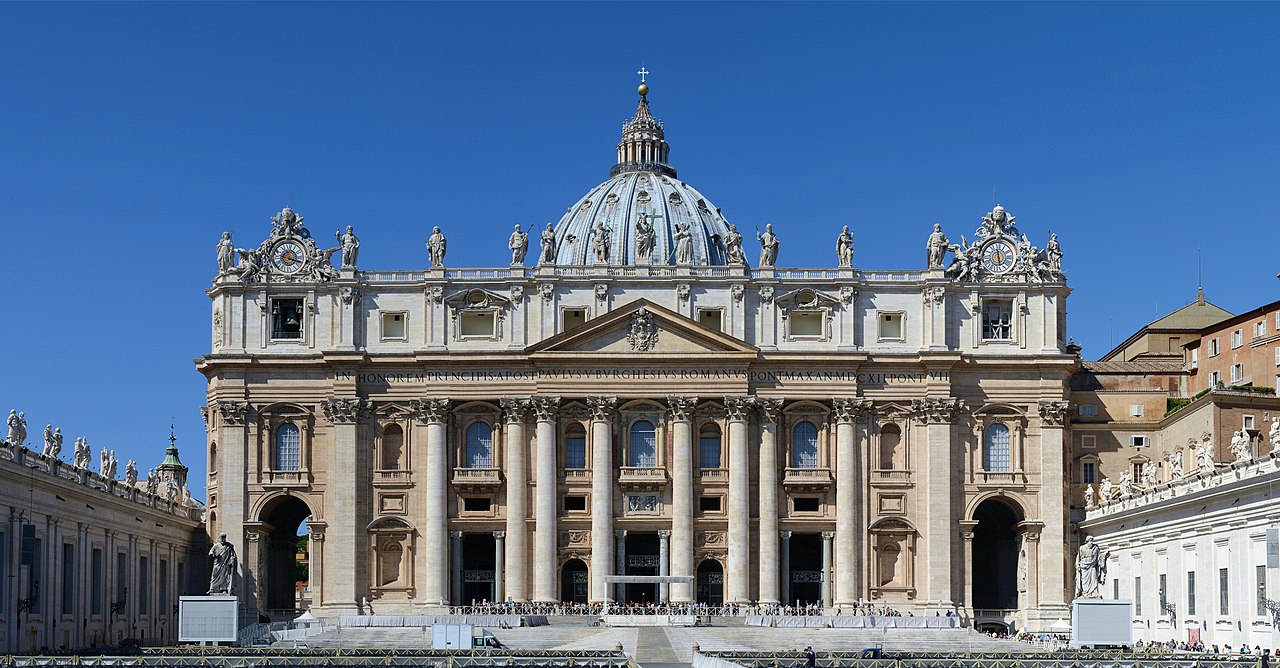
Saint Peter’s Basilica (Basilica di San Pietro) is the largest church in the world, 220 meters long, 156 meters wide at the transept, dome rising 136 meters above the floor. It is built on the site where Saint Peter was crucified upside-down in 64 AD under Emperor Nero and buried in a small necropolis. The current basilica was begun in 1506 and completed in 1626 — a 120-year construction involving Bramante, Raphael, Michelangelo, Bernini, and Maderno, the four greatest Italian architects of the period.
Inside: Michelangelo’s Pietà (1499) is immediately on the right when you enter — the marble sculpture of Mary holding the dead Christ, made when Michelangelo was 24. It is the only work he ever signed (he carved his name on Mary’s sash after overhearing visitors credit another artist). Behind bulletproof glass since a 1972 attack. Bernini’s Baldacchino (1623-1634) — the 29-meter-tall twisted bronze canopy over the high altar, marking the spot above Saint Peter’s tomb. The dome above (designed by Michelangelo, completed by Domenico Fontana in 1590) is 41.5 meters in diameter, the same proportion as the Pantheon dome.
The dome climb is 10 euros for elevator-to-roof-then-stairs (320 steps), or 8 euros for all stairs (551 steps). The first segment takes you to the roof terrace and the inside of the dome at the level of the inscription that runs around the base (“You are Peter, and on this rock I will build my Church”). The second segment is the steep climb up the inner shell of the dome — the walls curve inward and the spiral staircase becomes increasingly cramped (people over 1.85 m height struggle in the last section). The view from the top is the best panoramic of Rome — the formal Vatican Gardens directly below to the west, all of central Rome spread out to the east.
Allow 90 minutes for the basilica interior plus another 60-90 minutes for the dome climb. Dress code is strict — no bare shoulders, no shorts above the knee, no exposed midriffs. Guards turn away inappropriately dressed visitors. Bring a scarf or light jacket in summer to cover up.
Late Afternoon: Castel Sant’Angelo (4:30 PM – 6 PM)
Walk east along Via della Conciliazione (the grand pedestrian boulevard from Saint Peter’s to the river) to the Castel Sant’Angelo, the circular fortress at the edge of the Tiber. The building was originally the mausoleum of Emperor Hadrian, built between 134 and 139 AD as the burial place for himself and his successors. It was converted into a papal fortress in the 6th century, connected to the Vatican by the elevated Passetto di Borgo walkway (which popes used to flee to the castle during invasions and assassination attempts).
Tickets are 15 euros, the visit takes 60-90 minutes, the spiral ramp wound through the Roman core takes you up through five levels of papal apartments, prison cells, and military galleries. The terrace at the top has a bronze statue of the Archangel Michael sheathing his sword — commemorating the legend that Pope Gregory I saw the angel here during a plague in 590 AD, ending the disease.
The view from the terrace: Saint Peter’s Basilica directly across the Tiber to the west, the Pantheon dome to the east, the Spanish Steps and the Pincian Hill to the northeast. This is the sunset spot. If your day timing works, time the terrace visit for 30 minutes before sunset — the light on Saint Peter’s dome at dusk is the iconic Roman view, photographed every Audrey Hepburn movie about Rome.
Evening: Dinner in Prati or Centro Storico (7 PM – 10 PM)
For dinner, you are well-positioned near two excellent neighborhoods. Prati, the elegant residential area immediately north of the Vatican, has serious local restaurants. Centro Storico (the historic center east of the Tiber) is a 20-minute walk and has the famous piazzas and pasta institutions.
In Prati: Pizzarium Bonci (Via della Meloria 43) for the most-acclaimed Roman-style pizza by the slice (pizza al taglio) — thick, focaccia-style, with creative toppings, 5-7 euros per portion. Settembrini (Via Luigi Settembrini 25) for modern Roman cooking, 60 euros for a 3-course dinner with wine.
In Centro Storico: Armando al Pantheon (Salita dei Crescenzi 31) literally next to the Pantheon, traditional Roman cuisine, 40-50 euros per person, book a week ahead. Trattoria der Pallaro (Largo del Pallaro 15) — no menu, the host brings whatever Roman dishes she has cooked that day, 30 euros per person flat, an institution since 1979.
Day 3: Pantheon, Baroque Rome, Borghese
Day 3 is the day of central piazzas, Baroque sculpture, and one of the great small museums in Europe. The morning takes you through the iconic squares of the Centro Storico, the afternoon to the Borghese Gallery for Bernini’s most extraordinary marble sculpture.
Morning: Pantheon, Piazza Navona, Campo de’ Fiori (8 AM – 12 PM)
Begin at the Pantheon, the best-preserved Roman building from antiquity. Built between 113 and 125 AD under Emperor Hadrian (replacing an earlier 27 BC temple by Agrippa, whose name still appears on the portico inscription — “M. AGRIPPA L F COS TERTIUM FECIT”), the building has been in continuous use for 1,900 years. It was converted into a Christian church in 609 AD, which is why it survived intact while almost every other Roman temple was looted for stone.
Entry is free as of 2026 (a small 5-euro fee was introduced in 2023 but is currently suspended). The Pantheon opens at 9 AM. Arrive at 8:30 AM and look at the exterior — the massive granite columns of the portico, the bronze doors (the original 2nd-century doors, still functional). Inside, the geometry is unforgettable: the dome is a perfect hemisphere, 43.3 meters in diameter, exactly equal to the height from floor to oculus. The oculus (8.7 meters in diameter) is the only light source and the only opening to the sky — when it rains, the rain falls into the building and drains through small holes in the floor. The dome remained the largest unreinforced concrete dome in the world from 125 AD until the 20th century.
Raphael is buried inside (his tomb is in the third niche on the left). King Victor Emmanuel II (the first king of unified Italy, died 1878) and his son King Umberto I (assassinated 1900) are also buried here. 30 minutes is enough for the visit.
Walk three minutes west to Piazza Navona, the long oval Baroque square built on the foundations of Domitian’s Stadium (86 AD), where 30,000 spectators once watched athletic games. The current square layout was designed in the 17th century. The centerpiece is Bernini’s Fountain of the Four Rivers (Fontana dei Quattro Fiumi), 1651 — four monumental figures representing the Nile, Ganges, Danube, and Río de la Plata, supporting an Egyptian obelisk. Each figure shows a different gesture, each river has different animals and plants from its region. The fountain marks the high point of Roman Baroque sculpture.
The square also contains Borromini’s Church of Sant’Agnese in Agone (1652-1672) on the western side — the dramatic Baroque facade was designed by Bernini’s lifelong rival. The legend is that Bernini sculpted the Rio de la Plata figure shielding his eyes from the church facade in disgust, though the chronology proves this is myth (the fountain was finished before the church facade began).
Walk south to Campo de’ Fiori, the medieval square that hosts a daily morning market (closed Sundays). In the center stands the statue of Giordano Bruno, the philosopher burned alive on this spot on February 17, 1600, for heresy. The market sells flowers, fresh produce, spices, and increasingly tourist-oriented goods (kitchen gadgets and t-shirts). Walk through it, but for serious food shopping, go to the Mercato di Testaccio south of the center instead.
Late Morning: Trevi Fountain and Spanish Steps (12 PM – 1:30 PM)
Walk east 15 minutes through the Centro Storico to the Trevi Fountain — the most famous fountain in the world, the Baroque marble cascade completed in 1762 by Nicola Salvi. The fountain stands at the terminus of the Aqua Virgo aqueduct (built 19 BC, still functional). The pose of Oceanus on his shell chariot pulled by sea horses, the wild rocky base, the white travertine dazzling against the warm tones of the surrounding buildings.
The legend: throw one coin over your shoulder with your right hand into the fountain, you will return to Rome. Throw two coins, you will fall in love with an Italian. Throw three coins, you will marry that Italian. The fountain collects approximately 3,000 euros per day in coins, all donated to Catholic charity Caritas to fund a supermarket for Rome’s homeless.
It will be crowded. The piazza is small and the fountain attracts thousands per day. Go early (before 9 AM) or late at night (after 11 PM, when it is dramatically lit and the crowds are thinner) for any chance of a photo without other tourists. The morning visit is loud but the energy is part of the experience.
Walk 10 minutes north to Piazza di Spagna and the Spanish Steps — the 135-step monumental Baroque staircase built between 1723 and 1725 connecting the piazza to the Trinità dei Monti church at the top. The steps are a sitting ban now (since 2019, you can be fined 250 euros for sitting on the steps to discourage tourist congestion). At the bottom, Bernini’s Fontana della Barcaccia (1623) — a boat-shaped fountain that always intrigues children. Keats died in the house immediately right of the steps in 1821, age 25 — the building is now the Keats-Shelley Memorial House museum.
Lunch: A Roman Trattoria (1:30 PM – 3 PM)
For lunch near the Spanish Steps, walk five minutes east to Pier Luigi (Piazza dei Ricci 144, near Campo de’ Fiori) for serious Roman seafood pasta — spaghetti alle vongole, fritto misto. 50 euros per person.
Or stay simpler: Pizzeria Da Baffetto (Via del Governo Vecchio 114) for traditional Roman thin-crust pizza, 10-15 euros per person. Tonnarello (multiple locations) for cacio e pepe. Antico Forno Roscioli (Via dei Chiavari 34) for pizza al taglio, sandwiches, and the famous Roman supplied (deep-fried rice balls), 5-10 euros for a quick standing lunch.
Afternoon: Borghese Gallery (3 PM – 5 PM)
The Galleria Borghese is one of the best small museums in the world. It is housed in the Villa Borghese (the elegant residence built between 1605 and 1633 by Cardinal Scipione Borghese), set inside the 80-hectare Villa Borghese park. The collection holds Cardinal Scipione’s personal art collection — the best Bernini sculptures, the Caravaggios, and significant Raphael and Titian paintings.
Entry requires pre-booking and is strictly enforced — 25 euros, 2-hour timed slots, max 360 visitors per slot. Book at least 2 weeks ahead online at galleriaborghese.it. The visit must finish in your 2-hour slot.
The standouts: Bernini’s Apollo and Daphne (1625) — the white marble depicting the moment Daphne transforms into a laurel tree to escape Apollo. Her fingertips becoming leaves, her toes becoming roots, her flowing hair turning to branches. Carved from a single block, made when Bernini was 25-27 years old. It is the single most extraordinary piece of marble sculpting in Western art. Bernini’s David (1623-1624) — the moment David is winding up to throw the stone, body twisted, brow furrowed. Bernini used his own face as the model. Bernini’s Rape of Proserpina (1621-1622) — Pluto’s fingers visibly sinking into Proserpina’s marble thigh as he abducts her. The detail of one stone pressing into another stone, both being stone, is technically miraculous.
Caravaggio’s Madonna and Child with Saint Anne (1605) and Saint Jerome Writing. Titian’s Sacred and Profane Love (1514). Raphael’s Deposition (1507). Two hours is just enough. You will want to come back.
Late Afternoon: Villa Borghese Park (5 PM – 6:30 PM)
After the gallery, walk the surrounding Villa Borghese gardens. The 80-hectare park is the largest in central Rome, dotted with fountains, pine trees, jogging paths, the small artificial Laghetto lake (rentable rowboats, 4 euros for 20 minutes), the Bioparco (Rome’s zoo), the Carlo Bilotti Museum, and the panoramic Pincio Terrace at the southwestern edge.
Walk to the Pincio Terrace at 6 PM for sunset over central Rome. From here you see the dome of Saint Peter’s directly west, the entire historic center spread below, and the sun setting behind the Vatican. This is the second-best sunset view in Rome (after Castel Sant’Angelo terrace on Day 2).
Evening: Final Roman Dinner (7:30 PM – 10:30 PM)
For the final night, splurge or stay traditional. Splurge: Aroma at the Palazzo Manfredi (Via Labicana 125), the rooftop restaurant with floor-to-ceiling Colosseum views, one Michelin star, 150-euro tasting menu, the most expensive Colosseum view in town. La Pergola (Via Alberto Cadlolo 101, in the Rome Cavalieri hotel) for the most-decorated restaurant in Rome (three Michelin stars), 350-euro tasting menu, book 6-8 weeks ahead.
Traditional: Roscioli (Via dei Giubbonari 21-22), the famous restaurant-deli-wine bar inside an 1860s salumeria, 60 euros per person, book three weeks ahead. Trattoria Da Cesare al Casaletto (Via del Casaletto 45, southwestern outer Trastevere) for the most-loved trattoria in Rome, 35 euros per person, you must reserve.
Walk after dinner through Centro Storico one last time. Stop at Piazza Navona at midnight when the day-tourists are gone. Listen to the fountains. This is the Rome that the Romans live in — not the daytime tourist machine, but the dark, empty, beautifully lit ancient city you can imagine has not changed in 400 years.

Where to Stay in Rome: Best Neighborhoods
Rome’s historic center is the area inside the Aurelian Walls, divided into rioni (medieval districts) on the east bank of the Tiber and a few neighborhoods on the west. Stay inside the historic center for first-time visits — you walk to the Pantheon, Trevi, Colosseum, and you do not need to use the limited metro.
Find Your Rome Hotel
Compare prices across Booking.com, Expedia, Agoda and more in one search.
Search Rome Hotels →Centro Storico – The Tourist Heart
Centro Storico is the medieval and Renaissance city center between the Tiber and the Quirinal Hill — the Pantheon, Piazza Navona, Campo de’ Fiori, Piazza di Spagna, Trevi Fountain are all within this district.
Hotel de Russie (Via del Babuino 9) is the elegant luxury option — 19th-century building between Piazza del Popolo and the Spanish Steps, 122 rooms, beautiful tiered garden facing the Pincian Hill. From 650 euros per night. The Stravinskij Bar is one of the better hotel bars in Rome.
Hotel Raphael (Largo Febo 2) sits a 30-second walk from Piazza Navona, 50 rooms, the building covered in ivy. From 320 euros per night. Rooftop terrace restaurant with 360-degree views.
Hotel Smeraldo (Vicolo dei Chiodaroli 9) for budget-mid range — 50 rooms behind Campo de’ Fiori, small but properly maintained, traditional Roman decor. From 140 euros per night.
Trastevere – Authentic but Lively
Trastevere has the most atmospheric streetscape but is loud at night. Stay here if you want the medieval Roman feel and do not mind noisy weekends.
Hotel Santa Maria (Vicolo del Piede 2) is a 19-room boutique inside a former 16th-century convent, with an interior courtyard garden where breakfast is served. From 220 euros per night. Quiet despite the Trastevere location.
Monti – Hipster and Affordable
Monti is the gentrified medieval neighborhood between the Colosseum and Termini Station. Excellent restaurants, less tourist crush than Centro Storico, slightly more affordable hotels.
The Beehive (Via Marghera 8) is the famous boutique hostel-and-hotel hybrid — dorms from 35 euros, private rooms from 130 euros. Run by a Californian couple since 1999. Vegan breakfast available, garden patio.
Prati – Quiet and Near the Vatican
Prati is the upscale residential neighborhood adjacent to the Vatican. Stay here if you want quiet, the Vatican is your primary destination, and you do not mind being slightly less central.
Hotel della Conciliazione (Borgo Pio 167-169) is a small, traditional, family-run hotel five minutes from Saint Peter’s Square. From 180 euros per night.
Where to Eat in Rome
Roman cuisine is austere and ingredient-driven. The classic Roman pasta dishes use few elements (5-7 ingredients maximum), but the proportions and the timing must be perfect. The four Roman pastas are carbonara, cacio e pepe, amatriciana, and gricia — master those and you understand Roman cooking.
The Four Roman Pastas (where to eat each)
Carbonara — eggs, pecorino, guanciale (cured pork jowl), black pepper, pasta water. No cream. No bacon. Felice a Testaccio (Via Mastro Giorgio 29) has been making the most famous carbonara in Rome since the 1930s. 16 euros.
Cacio e pepe — pasta, pecorino, black pepper, pasta water. That is it. The trick is emulsifying the cheese and pasta water without it clumping. Felice a Testaccio also does this perfectly. Roma Sparita in Trastevere serves it in a hollowed-out parmesan wheel for theatrical effect.
Amatriciana — tomato, guanciale, pecorino, white wine, pepper. Originally from the town of Amatrice in Lazio. Da Danilo (Via Petrarca 13, near Termini) for the most-acclaimed amatriciana in Rome, 13 euros.
Gricia — the simplest, pecorino, guanciale, pepper, pasta water. Considered the ancestor of both carbonara (add eggs) and amatriciana (add tomato). Trattoria Da Teo (Piazza dei Ponziani 7, Trastevere) for excellent gricia.
Pizza al Taglio
Roman pizza by the slice (pizza al taglio) is a different animal from Neapolitan pizza — thicker focaccia-style base, sold by weight, cut with scissors. The temple is Pizzarium Bonci (Via della Meloria 43, Prati) — Gabriele Bonci’s pizza, 5-7 euros per slice depending on weight, creative toppings (pumpkin and gorgonzola, mortadella and pistachio, anchovy and orange peel). Lines form at lunch, eat standing.
Roman Jewish Cuisine
The Roman Jewish ghetto (between Largo Argentina and the Tiber) is the oldest continuously inhabited Jewish quarter in Europe — Jews have lived here since the 2nd century BC. The cuisine developed under restriction (forbidden ingredients, limited cooking methods) and produced unique dishes. Try carciofi alla giudia (artichoke fried whole until the leaves crisp like petals, sliced lemon underneath, traditionally eaten with the fingers). Nonna Betta (Via del Portico d’Ottavia 16) is the recognized institution for Roman-Jewish cooking, 35-45 euros per person.
Gelato
Roman gelato is excellent but only at the artisanal shops — avoid the gigantic colored mounds piled into the cones that you see at tourist spots (industrial gelato, full of stabilizers). True artisanal gelato is stored in covered metal tubs at proper temperatures.
Gelateria del Teatro (Via dei Coronari 65) for the best in Centro Storico — try the lavender, the rosemary-honey-lemon, or the chocolate Sambuco (with elderflower). 3.50 euros for a small.
Fatamorgana (multiple locations) for the most creative flavors in Rome — Sicilian basil-walnut-honey, gorgonzola, white chocolate-curry. 4 euros for a small.
Giolitti (Via degli Uffici del Vicario 40, near the Pantheon) for the classic since 1900.
Espresso Culture
Roman coffee culture has strict rules. Order at the cassa (cash register) first, get a receipt, then take it to the bar counter where the barista makes the coffee. Drinking at the counter is half the price of sitting at a table (in busy bars, an espresso is 1-1.30 euros standing, 3-4 euros sitting). Drink the espresso quickly, in 30 seconds, standing. Do not order a cappuccino after 11 AM (Italians find this gastronomically offensive — cappuccino is breakfast only). Do not order a latte (in Italian, latte just means milk — you will get a glass of milk).
For serious specialty coffee, try Faro – Luminari del Caffè (Via Piave 55) or Tram Depot (Via Marmorata 13, Testaccio) — both serving single-origin espresso and pour-over.
Getting Around Rome
Walking: The Default Mode
Most of central Rome is walkable. The historic center is genuinely small — Pantheon to Colosseum is 20 minutes on foot, Pantheon to Vatican is 30 minutes. Wear shoes with proper support — the sampietrini cobblestones are murder on flat sandals or heels. Bring a refillable water bottle and fill it from any of the 2,500 public nasoni fountains (the small cast-iron fountains with the curved spout, all dispense cold drinkable water).
Flights to Rome
Compare flight deals to Rome (FCO) from 100+ airlines and 1,000 agencies.
Search Flights to Rome →Metro and Buses
Rome’s metro system has only three lines: A (orange) running northwest to southeast through the historic center, B (blue) running north to south past the Colosseum, and the newer C (green) still being extended. The two lines meet at Termini Station. The metro is useful for getting from Termini to the Colosseum or the Vatican, less useful for moving within the historic center.
Buses cover everywhere the metro does not but they are slow, often crowded, and the routes are confusing. Use them only if walking is impractical. Use Citymapper or Moovit for real-time routing.
Tickets: 1.50 euros for a single 100-minute ticket (works on metro, bus, tram). 7 euros for a 24-hour pass, 12.50 for 48-hour, 18 for 72-hour, 24 for a weekly. Buy at metro stations, tabacchi (tobacco shops with the white T sign), or use the ATAC mobile app.
Taxis and Uber
Roman taxis must be official white cars with the meter visible. Refuse unmetered rides. Hail at official taxi stands or call 060609 (the city call center). Standard cross-historical-center fare is 12-18 euros. Uber operates only in luxury Black or Lux tiers (no UberX, banned by court ruling) and is significantly more expensive than taxis.
Airports
Rome has two airports. Fiumicino (Leonardo da Vinci) is 30 km southwest, handles most international flights. The Leonardo Express train runs every 15 minutes to Termini Station, 32 minutes, 14 euros. Taxi flat rate to historic center is 50 euros. Ciampino is 15 km southeast, handles budget airlines (Ryanair, Wizz). No direct train; use the Terravision or SitBus shuttle to Termini, 6 euros, 40 minutes. Taxi flat rate 30 euros.

What to Know Before You Go
Language
Italians speak less English than the French or Dutch, especially older Romans and in non-tourist areas. Learn the basics: Buongiorno (good day), Buonasera (good evening, after 4 PM), Grazie (thanks), Per favore (please), Mi scusi (excuse me), Quanto costa (how much), Il conto per favore (the check please), Un’altra birra per favore (another beer please).
Money and Tipping
Restaurants usually add a small coperto (cover charge) of 2-4 euros per person for bread and table setting. This is not a tip. Some also add servizio (service) of 10-15%. Read your bill carefully. Tipping is not expected on top of these charges — leaving 1-2 euros for good service is appreciated but never required. Bars: round up the espresso to the nearest euro if you sat at a table. Taxis: round up.
Credit cards work in most central restaurants and hotels. Small bars, market vendors, and some trattorias take cash only. Carry 50-80 euros in cash. ATMs (called bancomat) are everywhere; use bank-branded ones to avoid the high fees of Euronet machines.
Safety
Rome is generally safe — violent crime is rare. Pickpocketing is the actual risk, particularly in: the metro (lines A and B, especially between Termini and the Colosseum), the area around the Termini Station after dark, the Trevi Fountain crush, the entrance to the Vatican Museums, and the gypsy beggars who work the Spanish Steps and Pantheon with the cardboard-and-baby technique. Use a crossbody bag worn front, do not put your phone in your back pocket, and ignore anyone who tries to put a rose or a friendship bracelet on you (then demands payment).
Opening Hours
Most restaurants serve lunch 12:30-3 PM and dinner 7:30-11 PM. Many close 3-7:30 PM, but stalls and bars stay open. Sunday closures still apply to many small businesses and trattorias. Museums are typically closed on Mondays (the Vatican Museums are closed Sundays except the last Sunday of the month when entry is free — expect 3-hour lines). Most Roman shops close 1-4 PM for riposo (the Italian siesta), then reopen until 8 PM.
Best Time to Visit
April-May and October-November are the optimal windows — daytime temperatures 16-23°C, fewer crowds, manageable accommodation prices. July-August is hot (35-38°C peaks, brutal in the un-shaded Forum), crowded, and many local restaurants close for the August holiday (especially August 15, Ferragosto). December-March is cold (5-12°C) but quiet and atmospheric.
Common Mistakes First-Time Visitors Make
1. Not Booking the Vatican and Colosseum in Advance
Walk-up tickets for the Colosseum and Vatican Museums require 2-3 hour queues in peak season, or are entirely sold out. Book online at least one week ahead, ideally two weeks. The Borghese Gallery has even stricter time-slot enforcement — book 2-3 weeks ahead.
2. Eating Within 200 Meters of a Major Monument
Tourist-trap restaurants ring every major Roman monument. The unwritten rule is the better restaurants are at least one block off the tourist track. A bad pasta near the Trevi Fountain costs 22 euros; an excellent pasta two streets away costs 14 euros. The five-minute walk is always worth it.
3. Ordering a Cappuccino After 11 AM
Italians consider cappuccino a breakfast drink. Ordering one after a meal or in the afternoon flags you as a tourist and your barista may visibly cringe. After breakfast, order espresso, espresso macchiato (with a dab of foam), or caffè lungo (a longer-pulled espresso). If you want milk in the afternoon, ask for a caffè latte (still considered slightly odd) or a marocchino (espresso + cocoa + milk foam in a small glass).
4. Wearing Shorts to the Vatican
Saint Peter’s Basilica enforces a strict dress code: no bare shoulders, no shorts above the knee, no exposed midriffs. Same applies to many other major churches in Rome. Bring a light scarf or pareo to cover up if necessary. Guards turn away inappropriately dressed visitors at the door.
5. Trying to Cover Rome by Metro
Rome’s three-line metro is limited. It does not reach much of the historic center (no station at Piazza Navona, Pantheon, Trevi, or Campo de’ Fiori). Walking is faster for most central destinations. Use the metro for Vatican/Trastevere/outer neighborhoods only.
6. Throwing the Trevi Coin Wrong
The Trevi coin tradition specifies: right hand, over the left shoulder, with your back to the fountain. One coin (return to Rome). Two coins (you will fall in love with an Italian). Three coins (you will marry that Italian). Tourists frequently get this wrong and locals quietly laugh. Take a moment, do it properly, take the photo.
Estimated Costs: 3 Days in Rome
Budget (700-1,000 euros for 2 people, 3 nights)
Accommodation: 120-170 euros per night for a 3-star hotel in Monti, Trastevere, or Esquilino. Meals: 25-35 euros per person per day with cheap trattoria lunches (12-15 euros), pizza al taglio, and casual dinners. Transport: 18 euros for 72-hour metro pass. Attractions: 70-90 euros per person for Colosseum + Vatican Museums + Pantheon (free).
Mid-Range (1,200-1,800 euros for 2 people, 3 nights)
Accommodation: 200-280 euros per night for a 4-star or boutique in Centro Storico. Meals: 60-90 euros per person per day with at least one serious dinner at Felice a Testaccio, Da Enzo, or Roscioli. Attractions: 100-130 euros per person including the Borghese Gallery and arena floor at the Colosseum.
Luxury (2,800-6,000 euros for 2 people, 3 nights)
Accommodation: 500-1,200 euros per night at Hotel de Russie, Hotel Eden, Palazzo Manfredi, or Hotel Vilon. Meals: 120-300 euros per person per day including Michelin stars (Aroma, La Pergola). Private guides for the Vatican and Borghese. Skip-the-line everything.
Frequently Asked Questions
Is 3 days enough in Rome?
Three days is enough to see the essential Rome — Colosseum, Forum, Pantheon, Trevi, Vatican (museums plus Saint Peter’s), and one neighborhood like Trastevere. Four days is better if you want to add the Borghese Gallery comfortably or a day trip to Tivoli. Five days is ideal for a first visit. But three days is plenty to fall for the city.
When is the best time to visit Rome?
April-May and October-November are the sweet spots — mild weather (16-23°C), manageable crowds, lower prices than peak summer. Avoid July-August (35°C+, crowded). Winter (December-March) is cold but quiet and atmospheric.
How much does a 3-day Rome trip cost?
For two people: 700-1,000 euros budget, 1,200-1,800 euros mid-range, or 2,800+ euros luxury, all including accommodation, food, transport, and major attractions. International flights extra. Rome is similar in cost to Paris and slightly more expensive than Madrid or Lisbon.
Do I need to book Vatican tickets in advance?
Yes, absolutely. The Vatican Museums have 5+ million visitors a year. Walk-up tickets in peak season mean 2-3 hour queues. Book online at museivaticani.va at least 1-2 weeks ahead. Early-morning slots (7:30-9 AM) are best. Sundays are closed except the last Sunday of the month (free entry but 3-hour queues).
What should I wear in Rome?
Comfortable shoes are essential — you will walk 7-10 kilometers per day on cobblestones. For the Vatican and major churches, cover your shoulders and knees (no shorts, no bare shoulders). For dinner, smart casual is the default in better restaurants. In summer, lightweight breathable fabrics; in winter, a warm coat and waterproof shoes.
Is Rome safe?
Yes, very safe. Violent crime against tourists is rare. Pickpocketing is the main risk, especially in the metro, around the Termini Station, and at the most-crowded tourist sites. Use a crossbody bag worn in front, ignore scammers approaching with roses or friendship bracelets, and stay alert on the metro.
Can I drink the tap water in Rome?
Yes — Rome has excellent tap water. The 2,500 public nasoni fountains across the city all dispense cold, drinkable water. Bring a refillable water bottle and refill from any nasoni. Restaurants will serve tap water (acqua del rubinetto) on request, though most upsell bottled water by default.
How do I get from Fiumicino Airport to central Rome?
The Leonardo Express train runs from Fiumicino directly to Termini Station every 15 minutes, takes 32 minutes, costs 14 euros. Taxis are flat-rate 50 euros to the historic center. Avoid the airport-area gypsy taxi touts who approach in the terminal.
Related Travel Guides
Final Thoughts
Three days in Rome is a beginning, not a comprehensive visit. The city has 2,800 years of continuous human occupation and you cannot meaningfully see more than a fraction in any single trip. What you can do is build the foundation — see the unmissable monuments, eat at the unchanged trattorias, walk the medieval lanes at midnight when they empty out, throw the coin in the Trevi.
The city rewards return visits more than almost any other in Europe. The Romans who live here, the people who walk past the Pantheon to get a coffee on the way to work, do not see the monuments anymore. They see streets, neighborhoods, people, food. Three days starts you toward seeing Rome that way — not as a checklist of monuments, but as a city you might, eventually, learn.
