


Tokyo is the largest metropolitan area in the world. 37 million people live in the greater Tokyo region — more than all of Canada. The city is so vast that locals do not think of “going to Tokyo” the way Parisians might say “going to Paris” — they go to Shibuya, to Asakusa, to Shinjuku, to Ginza. Each ward (and there are 23 in the city proper) has its own personality, its own train stations, its own gravity.
This itinerary covers the three Tokyos that define the city: old Tokyo (Asakusa, Yanaka, Ueno — the Edo-era neighborhoods with temples, gardens, and the only buildings older than 1945), modern Tokyo (Shibuya, Shinjuku, Harajuku — the neon, the crossings, the youth culture, the soaring train station hubs), and elegant Tokyo (Ginza, Marunouchi, the Imperial Palace area — the museums, the department stores, the tea ceremonies). Three days, around 25 kilometers of walking, and you will use the train system at least 20 times.
- Why 3 Days Works (and What You Will Miss)
- Day 1: Old Tokyo — Asakusa, Ueno, Yanaka
- Day 2: Modern Tokyo — Shibuya, Harajuku, Shinjuku
- Day 3: Tsukiji, Ginza, Imperial Palace
- Where to Stay in Tokyo: Best Neighborhoods
- What to Know Before You Go
- Getting Around Tokyo
- Where to Eat in Tokyo
- Common Mistakes First-Time Visitors Make
- Estimated Costs: 3 Days in Tokyo
- Frequently Asked Questions
- Final Thoughts
Why 3 Days Works (and What You Will Miss)
Tokyo’s geography is post-1945. Two-thirds of the city was destroyed in the firebombing campaigns of March-May 1945 — over 100,000 civilians killed in single nights, more than the immediate deaths at Hiroshima. The rebuilt city is therefore mostly post-war: low-rise concrete, neon, glass towers, with isolated pockets of pre-war wooden architecture in Yanaka, Asakusa, Kagurazaka. Add to this the relentless turnover of building stock — the average commercial building in Tokyo is demolished and rebuilt every 26 years — and you get a city that feels constantly under construction even as parts of it preserve 400-year-old temples and Edo-era street grids.
Three days lets you cover the essential wards: Asakusa (Sensō-ji temple and the old town), Shibuya and Harajuku (the iconic scramble crossing, the fashion district), Shinjuku (the nightlife and skyline), Tsukiji or Toyosu (the fish market culture), Ginza (the shopping district), and maybe a half-day in Ueno or Yanaka (parks, museums, old neighborhoods). You will not have time for day trips to Mount Fuji, Hakone, Kamakura, or Nikkō. You will not see the western suburbs (Kichijōji, Shimokitazawa, Naka-Meguro) properly. You will not visit the major museums (Tokyo National Museum, Ghibli Museum) in depth.
What three days gives you is the feeling of Tokyo: the choreographed efficiency of 3,000 people crossing a single intersection in 90 seconds at Shibuya, the smell of grilled yakitori from a 6-seat counter under elevated train tracks, the abrupt transition from a roaring 8-lane avenue to a silent shrine garden, the way Japanese politeness operates as a kind of social machinery that makes 37 million people coexist without friction.
If you have four or five days, add Kamakura (the Great Buddha and the 13th-century shogun capital, 60 minutes by train), Nikkō (the elaborate mausoleums of the Tokugawa shoguns), or a day to recover and explore one neighborhood slowly. Mount Fuji is a difficult day trip from Tokyo — most of what tourists actually see is Hakone, the lakeside resort area at Fuji’s base, which takes a full day with travel.
Day 1: Old Tokyo — Asakusa, Ueno, Yanaka
Start with the city’s oldest district. Asakusa was the entertainment quarter of Edo (Tokyo’s pre-1868 name) and remains the most visibly historic neighborhood despite heavy bombing in 1945. The morning walks you through Sensō-ji temple, the afternoon takes you north to Ueno Park and the maze of Yanaka.
Morning: Sensō-ji and Nakamise-dōri (7:30 AM – 10:30 AM)
Take the Ginza Line metro to Asakusa Station and emerge at the Kaminarimon (Thunder Gate). The 11.7-meter-tall red gate with the 700-kilogram paper lantern marks the entrance to Sensō-ji, Tokyo’s oldest Buddhist temple, founded in 645 AD. The current buildings are 1958-1973 reconstructions — the original was destroyed in the 1945 firebombing, the largest single loss of historic Tokyo architecture in a single night.
Arrive at 7:30 AM. The temple grounds are technically open 24 hours; the main hall opens at 6 AM. Between 7:30 and 9 AM you have the place largely to yourself — hundreds of buses begin disgorging tour groups at 9:30 AM and by 11 AM the central path is wall-to-wall people. Walk through the Kaminarimon, then along Nakamise-dōri — the 250-meter shopping street with 89 wooden stalls leading to the inner Hozomon gate. Most stalls open at 9 AM; if you are too early, walk the side streets and come back.
The shopping street stalls sell traditional Japanese souvenirs: ningyō-yaki (small cake filled with sweet bean paste, sold warm, 100 yen each), kimono accessories, fans, lucky charms, handmade chopsticks. The institution to try is Asakusa Kibidango Azuma (millet-flour dumplings on skewers with sweet soy sauce, 350 yen for five sticks, sold from a small wooden cart at the start of Nakamise). The street is consciously preserved as it would have looked in the late Edo period — lanterns, wooden facades, traditional signs.
Through the Hozomon (inner gate, with its giant straw sandals symbolizing the size of the Buddha), the main hall (Hondō) rises ahead. Before entering, stop at the central incense burner (jōkōro) and waft the smoke over yourself — the belief is that the smoke purifies. The five-story pagoda on the left side of the main hall is one of the tallest in Japan, 53 meters. Visit takes 60-90 minutes.
Walk five minutes east to Asakusa Engei Hall for old-style Japanese variety entertainment (rakugo storytelling, traditional comedy) if your schedule aligns with show times, or down to the Sumida River for views back at the Tokyo Skytree (the 634-meter broadcasting tower, the tallest tower in the world, opened in 2012 — visible from across the river).
Mid-Morning: Kappabashi Kitchen Street (10:30 AM – 12 PM)
Walk 15 minutes west to Kappabashi-dōri — the 800-meter “kitchen town” with 170+ shops specializing in restaurant supplies, traditional knives, ceramics, plastic food samples (the realistic plastic dishes you see displayed in restaurant windows), and Japanese cookware. Anyone interested in cooking should make this a deliberate stop.
Highlights: Tsubaya Knives for premium Japanese kitchen knives (a single hand-forged Aogami steel knife costs 18,000-50,000 yen), Maizuru for the plastic food samples (you can buy them as souvenirs — a plastic ramen bowl is 5,000 yen, but smaller items like sushi pieces are 1,200 yen each), Kama-Asa for traditional cast-iron tea pots, Iida Shoten for chopsticks. Most shops open 9 AM, closed Sundays.
Lunch: Asakusa Tempura or Soba (12 PM – 1:30 PM)
Asakusa has two great traditional lunch options: tempura and soba. Daikokuya Tempura (1-38-10 Asakusa) has been frying tempura since 1887. The classic order is tendon — four large pieces of tempura (shrimp, fish, vegetables) on a bowl of rice with a slightly sweet soy sauce. 2,500 yen. Expect a line of 15-30 minutes at noon. Owariya (1-7-1 Asakusa) for handmade soba (buckwheat noodles), 1,500-2,500 yen for a bowl. Tradition: slurp loudly — it is considered polite and demonstrates appreciation.
Afternoon: Yanaka (1:30 PM – 4:30 PM)
Take the metro to Nezu Station (Chiyoda Line) and walk into Yanaka — one of the very few central Tokyo neighborhoods that survived the 1923 Kantō earthquake and the 1945 firebombing largely intact. The area still has wooden houses from the late Meiji period (1900-1912), narrow lanes that pre-date cars, dozens of small temples and shrines, and one of the most atmospheric cemeteries in Japan.
Walk Yanaka Ginza — the 170-meter shopping street that locals call “the street where time stopped.” Small family-run shops: a 100-year-old fish shop, a tea shop that has roasted its own leaves on site since the 1920s, fresh tofu makers, a senbei rice cracker shop. Try the menchi-katsu (deep-fried minced meat cutlet, eaten on the street) at Niku no Suzuki, 280 yen each.
Walk south through the Yanaka cemetery — the 25-hectare cemetery is the resting place of the last shogun Tokugawa Yoshinobu, novelist Mori Ōgai, and 7,000 others. The central avenue is lined with cherry trees — in late March-early April this is one of the most beautiful (and quiet) hanami spots in Tokyo.
Stop at Kayaba Coffee (6-1-29 Yanaka), a 1916 wooden café restored to its Showa-era state. The signature is the egg sandwich (450 yen) and the milkshakes — thick, made with real eggs and milk, served in the original glass.
Late Afternoon: Ueno Park (4:30 PM – 6 PM)
Walk south 10 minutes to Ueno Park, Tokyo’s first public park (opened 1873), 53 hectares, home to the most concentrated collection of museums in Japan: Tokyo National Museum (the world’s largest collection of Japanese art, 110,000+ objects), National Museum of Western Art (Le Corbusier-designed building, recently restored), National Science Museum, Ueno Zoo (Japan’s oldest, home to the giant pandas), Shitamachi Museum (recreated Edo-era streets).
You will not have time to visit them properly on this day — just walk through the park. The Bentendō temple on Shinobazu Pond, surrounded by lotus flowers in summer. The Toshōgū shrine (1627), one of the few surviving Edo-period buildings in Tokyo, dedicated to the first shogun Tokugawa Ieyasu, with bronze and stone lanterns donated by feudal lords across Japan. In cherry blossom season (late March-early April), the park’s 1,000+ cherry trees turn it into one of the most famous hanami spots in Japan.
Evening: Asakusa Dinner and Sumida Riverside (7 PM – 10 PM)
Take the metro back to Asakusa for dinner. The neighborhood has serious traditional restaurants — the kind of places that have served the same dishes for generations.
Komagata Dojo (1-7-12 Komagata) has been serving the same dish since 1801: dojo (Japanese loach fish) cooked in a shallow pan over charcoal at your table, with miso. 5,000-7,000 yen per person. Sit on the tatami mats in the upstairs room. Asakusa Imahan (3-1-12 Nishi-Asakusa) for premium sukiyaki and shabu-shabu (hot pot beef dishes), 10,000+ yen per person, the institution since 1895.
For something casual: Hoppy-dōri, the narrow alley between Asakusa Station and Sensō-ji lined with 20+ izakaya (Japanese pubs), packed with elbow-to-elbow tables under red lanterns. Order yakitori (grilled chicken skewers), edamame, beer, sake. 3,000 yen per person.
After dinner, walk to the Sumida River for views of the Tokyo Skytree illuminated against the night sky. The tower changes color every hour (alternating blue, purple, and pink) and is visible from many points along the riverside walking path.
Day 2: Modern Tokyo — Shibuya, Harajuku, Shinjuku
Day 2 is the iconic neon Tokyo you imagined when you booked the trip. Shibuya and its famous crossing, Harajuku’s youth fashion alley, the Meiji Shrine inside the city’s largest forest, then Shinjuku for the skyline and the nightlife.
Morning: Meiji Shrine and Yoyogi Park (8 AM – 10:30 AM)
Take the train to Harajuku Station (Yamanote Line, line JY20) or Meiji-Jingūmae Station (Chiyoda Line). Walk into the cypress-and-cedar forest that surrounds the Meiji Shrine. The shrine was built in 1920 to deify Emperor Meiji and Empress Shōken, who ruled during the rapid modernization of Japan (1867-1912). The original building burned during World War II; the current shrine is a 1958 reconstruction.
The forest is the surprise. 70 hectares of dense old-growth forest in the middle of central Tokyo, with 120,000 trees planted between 1915 and 1920. The walk from Harajuku Station to the main shrine takes 15 minutes along a wide gravel path through huge wooden torii gates. The largest, the second torii, is 12 meters tall and made from a 1,500-year-old hinoki cypress from Taiwan.
The shrine itself is free to enter and tranquil. Arrive at 7:30-8 AM for the calmest experience. You will likely see a Shinto wedding procession on weekends — the bride in white kimono, the groom in formal black kimono with hakama trousers, the priests in flowing robes leading them across the gravel courtyard. Buy an ema (small wooden tablet, 500 yen) and write a wish, hang it on the rack. Drink from the temizuya (water basin) the ceremonial way: ladle water over left hand, then right, then pour into left hand to rinse mouth, then run the ladle vertically to rinse the handle.
Walk south through the forest to exit at the south entrance, leading into Yoyogi Park — the 54-hectare park where Tokyoites come on weekends for picnics, sports, street performers, and (on Sundays) the famous rockabilly dancers near the entrance who have been gathering in 1950s outfits to dance to Elvis records every Sunday since the 1980s.
Mid-Morning: Harajuku (10:30 AM – 12:30 PM)
Walk east from Yoyogi Park to Harajuku and the famous Takeshita-dōri — the 350-meter pedestrian street that is the center of Japanese youth fashion since the 1980s. The street is overwhelming — narrow, packed, sensory-saturated with neon signs, sweet smells, J-pop blaring from speakers. Walking it once for the experience is enough. Try a Marion Crepes from the eponymous stall (Harajuku institution since 1976) — thin crepes wrapped around whipped cream, strawberries, ice cream, in dozens of combinations. 600-800 yen.
For more interesting shopping, walk south to Omotesandō — the broader, tree-lined boulevard known as Tokyo’s Champs-Élysées. Architecturally famous buildings: the Prada Aoyama building (Herzog & de Meuron, 2003, the diamond-pattern glass facade), Dior Omotesando (SANAA), Tod’s Omotesando (Toyo Ito). Even if you do not enter the stores, these buildings are masterpieces of contemporary Japanese-influenced architecture.
Side streets off Omotesandō hide better shopping: Cat Street (Ura-Harajuku) for independent Japanese designers and vintage. Aoyama for Issey Miyake, Comme des Garçons, and Yohji Yamamoto flagships.
Lunch: Ramen or Sushi (12:30 PM – 2 PM)
For ramen near Harajuku: Afuri Harajuku (3-63-1 Sendagaya) for the famous yuzu-shio ramen — light citrus-and-salt broth, more refined than the heavy tonkotsu style. 1,200 yen. Ichiran Shibuya (the famous private-booth ramen chain) at Shibuya Crossing branch — you order via a vending machine, then eat in a single-person booth with curtains, the focus entirely on the bowl. 1,000 yen.
For sushi: Numazuko Conveyor Belt Sushi in Shibuya for casual kaitenzushi at affordable prices (130 yen for basic plates, up to 600 yen for premium nigiri). Sit at the counter, take plates as they pass on the conveyor. Sushi Sho Tomokazu for the splurge — omakase tasting menu with the chef, 15,000 yen, must reserve weeks ahead.
Afternoon: Shibuya (2 PM – 5 PM)
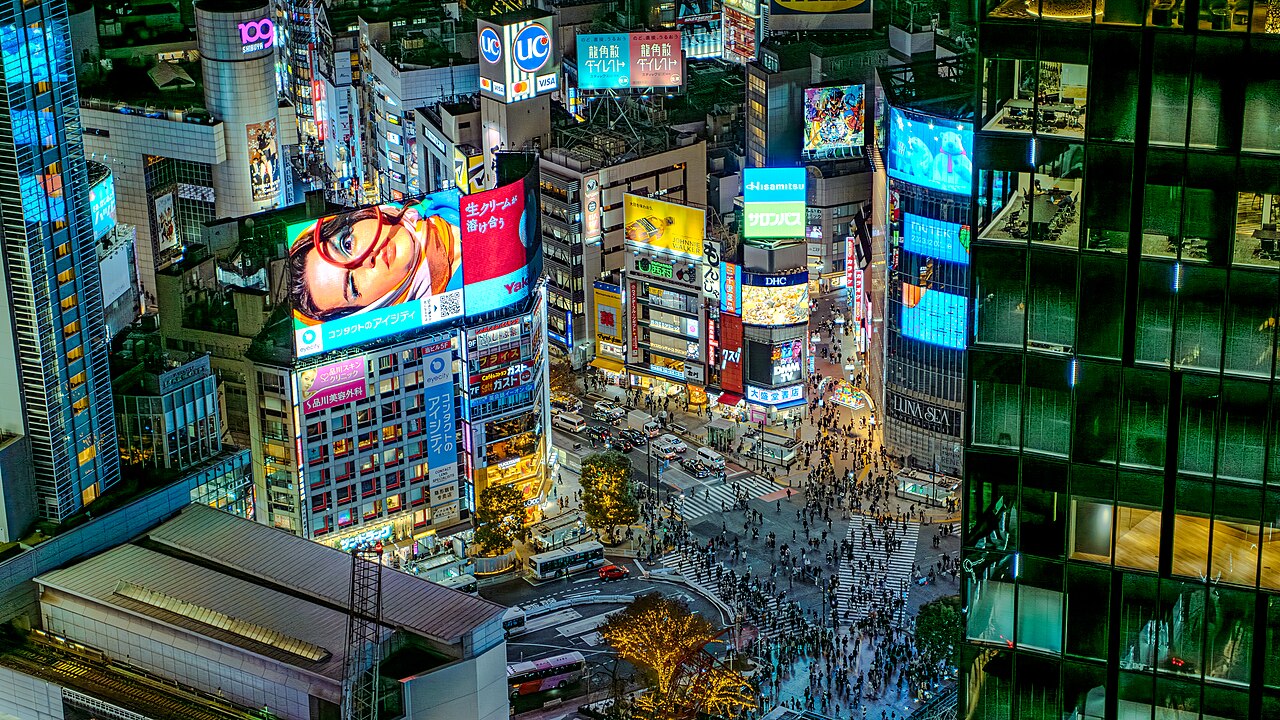
Walk south or take one stop on the Yamanote to Shibuya Station. The Shibuya Scramble Crossing immediately outside the station is the busiest pedestrian intersection in the world — up to 3,000 people cross simultaneously when all five crosswalks turn green at once, every 2 minutes during peak hours. From above, on the second floor of the Shibuya Tsutaya bookstore or in the Starbucks at the corner, the scramble looks choreographed: 3,000 people, no collisions, then 90 seconds of stillness.
Iconic Shibuya spots: the Hachikō statue outside the station, commemorating the Akita dog who waited at this spot for his deceased owner every day from 1925 to 1935 (the Japanese symbol of loyalty). The 109 building (Tokyo’s famous youth fashion mall). Shibuya Sky on the top of the 230-meter Shibuya Scramble Square building — the outdoor rooftop observatory with 360-degree views, 2,500 yen, book online. Sunset slots sell out 2 weeks ahead.
Walk into the smaller streets off the main scramble — Center-gai (the pedestrian street going north from the crossing) and the maze of alleys behind. Vintage shops, record stores, ramen joints, izakaya. Mandarake (the famous secondhand manga, anime, and pop-culture store) is here — 8 floors of collectibles.
Evening: Shinjuku Skyline and Nightlife (5:30 PM – 11 PM)
Take the Yamanote Line three stops to Shinjuku Station — the busiest train station in the world, with 3.5 million passengers per day moving through 200+ exits across multiple lines. Navigate using the JR East signs (white text on green background). Exit at the West Exit if your destination is the skyscraper district, the South Exit for Takashimaya and Nyū-Minamiguchi, the East Exit for Kabukichō, the Central Exit for the main concourse.
For sunset over the skyline: Tokyo Metropolitan Government Building Observatory — the 202-meter twin-tower building is FREE to enter (most rooftop observatories in Tokyo cost 1,800-2,500 yen). Take the high-speed elevator to the 45th floor. The north tower is open 9:30 AM to 11 PM. On clear days you can see Mount Fuji 100 km southwest, particularly between November and February when winter air is dry.
Walk east through the underground passages or above-ground to the Omoide Yokocho (“Memory Lane,” also called Piss Alley by locals) — the narrow alley of 70+ tiny 5-8 seat yakitori bars under the railway tracks just north of Shinjuku Station. Most stalls have been operating since the 1940s, smoke-filled, dim, the menu chalkboard hand-written in Japanese. Order yakitori sticks (200-400 yen each), a glass of beer (500 yen) or shochu, and just point at what others are eating if the menu defeats you. Total bill 2,000-3,000 yen per person. The cooks speak about 10 words of English at most; the experience is the point.
For more elaborate dinner: Sushi Saito (3-star Michelin, almost impossible to book directly, your hotel concierge may have access), New York Bar at the Park Hyatt (52nd floor, the famous Lost in Translation setting, jazz nightly, 3,300 yen cover after 8 PM but you get a serious cocktail experience), Robot Restaurant in Kabukichō (the famous dinner show with giant robot battles and lasers, around 9,500 yen — deliberately overstimulating, an experience rather than a meal).
Kabukichō (the entertainment district north of Shinjuku Station) is Tokyo’s largest red-light district — hostess bars, host clubs, izakaya, karaoke, sex shops. Walking through Kabukichō is safe (police presence is heavy) but avoid the touts who try to lure you into clubs (they often hide bait-and-switch pricing). Golden Gai is the more authentic experience — 6 narrow alleys with 200+ tiny bars (most have 4-8 seats), each a personality unto itself. Some bars charge a 1,500 yen cover for non-regulars, some refuse foreigners. Try Albatross G (Golden Gai, 5th street) — foreigner-friendly, English menu, 1,500 yen cover.
Day 3: Tsukiji, Ginza, Imperial Palace
Day 3 is the elegant Tokyo — the morning at the legendary fish market area for breakfast, the afternoon in Ginza and the Imperial Palace gardens, and an evening choice between traditional kabuki theater or a contemporary food experience.
Morning: Tsukiji Outer Market (7 AM – 10:30 AM)
The inner Tsukiji wholesale fish market moved to Toyosu in October 2018, but the Tsukiji outer market (the retail and food stalls outside the wholesale area) remains in its original location and is unchanged. Arrive at 7 AM for the most active period — stalls open around 5 AM and start closing at 1-2 PM. Take the Hibiya Line to Tsukiji Station or Oedo Line to Tsukiji Shijō Station.
The outer market is approximately 4 blocks square of food and kitchen-supply stalls. Make this a moving breakfast — walk and eat as you go. Essentials to try: tamago (Japanese omelet) on a stick from Yamacho Tamagoyaki, sweet and umami, 100-150 yen per stick. Fresh tuna nigiri at Sushi Dai’s queue-less alternative Daiwa Sushi (1,800-3,000 yen for a 6-piece set). Uni (sea urchin) from a stall serving it on a small plate of rice for 1,500 yen. Saikōrō for high-end wagyu beef skewers, 600 yen per stick. Marutoyo for fresh oysters opened in front of you, 400-600 yen each.
Side stalls sell dried bonito flakes, dried sardines, knives, ceramics, kitchen towels, tea. If you want a serious chef’s knife, this is where to buy one (3,000-50,000 yen range, the master sharpener at Aritsugu has been here since 1560 and the staff will hand-grind your initials into the blade for free).
If you have time and want the actual wholesale auction, that requires going to Toyosu (Yurikamome Line, takes 30 minutes from Tsukiji) and pre-registering for the tuna auction observation deck — 5:30 AM start, 120 lottery slots per day, reserved months ahead. Skip the Toyosu tuna auction on a 3-day trip; the outer Tsukiji market is the better cultural experience.
Late Morning: Ginza (11 AM – 1 PM)
Walk 10 minutes northwest to Ginza — Tokyo’s elegant shopping district, the equivalent of Manhattan’s Fifth Avenue or Paris’s Rue Saint-Honoré. The neighborhood’s history is interesting: it was built up by foreign architects in the 1870s during the Meiji modernization as a showcase district of “Western” brick buildings, destroyed in the 1923 earthquake, rebuilt as the first modern shopping street in Japan, destroyed again in 1945 bombing, rebuilt as Tokyo’s luxury retail anchor.
Walk Chūō-dōri, the main shopping artery. On weekends from 12 noon to 5 PM the avenue closes to cars and becomes a pedestrian zone (“Hokosha Tengoku” — pedestrian paradise). Architectural highlights: Wakō Building (the iconic clock tower at the Ginza 4-Chōme intersection, the symbol of Ginza since 1932), Mikimoto pearl flagship (the originals of cultured pearls, founded in Ginza in 1899), Mitsukoshi Ginza (the historic department store, founded 1673 as a kimono shop), Itoya (the 12-story stationery and writing supplies store, an institution for Japanese paper and brush calligraphy).
For traditional Japanese sweets and tea, HIGASHIYA Ginza (2-2-6 Ginza) inside the Pola Ginza Building is a serious tea salon serving high-grade matcha (1,500 yen) with seasonal wagashi (Japanese sweets). Reservation suggested.
Lunch: Ginza Quality Lunch (1 PM – 2:30 PM)
Ginza has the densest concentration of high-quality lunch in Tokyo. Most Michelin-starred restaurants offer lunch sets at one-third the price of dinner, making it possible to eat at world-class restaurants for 3,500-8,000 yen at noon rather than 20,000+ yen at dinner.
Ten-Ichi Ginza (6-6-5 Ginza) for premium tempura since 1930, lunch sets from 4,500 yen. Sushi Aoki (6-7-4 Ginza) for omakase sushi lunch at 5,500 yen. Kyubey (8-7-6 Ginza) for sushi institution since 1935, lunch from 6,000 yen. All require advance reservations even at lunch.
For casual but excellent: Trattoria Tsukiji (Italian-Japanese fusion at the edge of Ginza near Tsukiji), Ginza Kojyu (3-star Japanese kaiseki for splurge lunch).
Afternoon: Imperial Palace and East Gardens (2:30 PM – 5 PM)
Walk 15 minutes northwest from Ginza to the Imperial Palace. The palace itself (where Emperor Naruhito lives) is not open to the public except on two days per year (December 23 for the Emperor’s Birthday and January 2 for the New Year). However, the East Gardens are open year-round and free — they contain the partially-restored foundations of Edo Castle, which from 1603 to 1867 was the political center of Japan and the world’s largest castle.
The East Gardens (Kokyo Higashi Gyoen) cover 21 hectares. Walk up to the Honmaru, the former main inner ground of the castle, now a wide open lawn where you can see the giant moss-covered stone foundation of the original 1638 castle keep (which burned in 1657 and was never rebuilt). The Ninomaru garden on the eastern side is a beautifully maintained traditional Japanese strolling garden with a pond, seasonal flowers, and a small replica tea house.
From the Otemon gate (the eastern entrance), walk a 15-minute loop. From the Sakuradamon (the southern entrance, on the way to Hibiya), you can take the Niju-bashi photo — the famous double-arched stone bridge over the inner moat with the white palace turrets in the background.
Evening: Kabuki, Robot, or Casual Izakaya (6 PM – 10 PM)
For the final evening, choose your Tokyo: traditional, contemporary spectacle, or pure local experience.
Kabuki at the Kabuki-za Theater (4-12-15 Ginza) for the most accessible traditional Japanese theater. The theater rebuild in 2013 was beautiful. Full performances are 4-5 hours and 15,000-22,000 yen, but you can buy single-act tickets for 800-2,000 yen — perfect for first-timers. Acts last 45-90 minutes. English audio guides available. The makeup, costumes, and stylized movement are unforgettable even without understanding the dialogue.
Contemporary spectacle: teamLab Planets in Toyosu — the immersive digital art experience (4,800 yen, book online weeks ahead, allow 90 minutes). Walking through pools of water with infinite reflections, rooms full of slowly-blooming digital flowers projected onto every surface, drifting through clouds of LED lights.
Local experience: a serious izakaya dinner. Akamon (Shinjuku) for charcoal-grilled meats. Donjaca (Shibuya) for elaborate yakitori — each chicken part on its own skewer, ordered individually. Manten Sushi (multiple locations) for high-quality omakase at moderate prices. 5,000-8,000 yen per person with drinks.

Where to Stay in Tokyo: Best Neighborhoods
Tokyo’s vastness means your hotel neighborhood heavily affects your trip. Stay near a major Yamanote Line station — the circular train line that connects most central neighborhoods. Shinjuku, Shibuya, Tokyo Station, and Ueno are the most convenient hubs.
Find Your Tokyo Hotel
Compare prices across Booking.com, Expedia, Agoda and more in one search.
Search Tokyo Hotels →Shinjuku – Best for Transport Access
Shinjuku has the busiest train station in the world and trains to almost everywhere. The neighborhood is loud, chaotic, energetic, and ideal if you want to be in the middle of the action and have easy access to other parts of Tokyo.
Park Hyatt Tokyo (3-7-1-2 Nishi-Shinjuku) is the legendary luxury option — the hotel from “Lost in Translation,” 178 rooms occupying the top 14 floors of the Shinjuku Park Tower with city panoramas. From 62,000 yen per night. The 52nd-floor New York Bar is a destination in itself.
Hotel Gracery Shinjuku (1-19-1 Kabukichō) for mid-range with personality — the giant Godzilla head on the 8th-floor terrace, 970 rooms, in the heart of Kabukichō. From 15,000 yen per night. Walking distance to Shinjuku Station and the nightlife.
Citadines Central Shinjuku for serviced apartment-style rooms with kitchenettes, great for longer stays. From 13,000 yen per night.
Shibuya – Trendy and Young
Shibuya is more youth-oriented than Shinjuku, with the famous scramble crossing as your front door.
Cerulean Tower Tokyu Hotel (26-1 Sakuragaoka-chō) is the established 4-star — 411 rooms, walking distance to Shibuya scramble, Mark City entrance to the station, full hotel facilities including a 19th-floor jazz club. From 22,000 yen per night.
The Knot Tokyo Shinjuku for design-led mid-range with character. Trunk Hotel (Cat Street) for the boutique design experience near Harajuku.
Ginza / Marunouchi – Elegant and Quieter
Ginza and the adjacent Marunouchi (around Tokyo Station) are upscale, quieter at night, with the best access to the Imperial Palace and Tsukiji.
The Peninsula Tokyo (1-8-1 Yurakuchō) is the elegant luxury choice — 314 rooms, classic luxury hotel, walking distance to Ginza and Imperial Palace. From 75,000 yen per night.
Mandarin Oriental Tokyo (2-1-1 Nihonbashi-Muromachi) for the Nihonbashi luxury — high-floor city views, two Michelin-starred restaurants in the hotel.
Asakusa – Traditional and Affordable
Asakusa is the most affordable central area with the strongest traditional atmosphere. Slightly less convenient for transport than Shinjuku/Shibuya but charming.
The Gate Hotel Asakusa Kaminarimon by HULIC for the boutique mid-range — 137 rooms, 13th-floor rooftop bar with views to the Skytree, directly across from the Kaminarimon. From 20,000 yen per night.
Mustard Hotel Asakusa for design budget option, from 12,000 yen.
What to Know Before You Go
Language
Tokyo signage in English has improved dramatically since the 2020 Olympics preparation. Most subway signs, major restaurants, hotels, and tourist sites have English signs or staff who speak basic English. Off the tourist track and in small establishments, English is limited. Useful Japanese: Sumimasen (excuse me, sorry), Arigatō gozaimasu (thank you, formal), Eigo o hanasemasu ka (do you speak English), Kore wa ikura desu ka (how much is this).
The Google Translate camera function (point your camera at Japanese text to get instant translation) is the single most useful piece of technology for a Tokyo trip. Download offline Japanese.
Money and Cash
Japan is still surprisingly cash-heavy compared to Western Europe or the US. Many small restaurants, izakaya, food stalls, and older shops are cash-only. Carry 30,000-40,000 yen per day in cash. ATMs at 7-Eleven convenience stores accept all international cards and are the most reliable; Japan Post ATMs also work. Bank ATMs are limited hours (often close 9 PM, closed weekends).
Tipping is not just unnecessary, it can be offensive. Service is included in restaurant prices. Leaving cash on the table or trying to add tip is considered confusing or rude. Polite “Gochisōsama deshita” (thank you for the meal) when leaving is the correct gesture.
Public Transport
Tokyo’s train and subway system is extensive and confusing. Get a Suica or Pasmo IC card at any major station (1,000 yen card plus 1,000+ yen credit, or via the digital wallet on iPhone). Tap in and out at every train station. Works on all JR lines, Tokyo Metro, Toei Subway, buses, and many other transport systems across Japan. Most rides cost 170-310 yen; the daily passes are usually not better value than pay-as-you-go.
Trains run from 5 AM to about midnight — there are no night trains. The last trains are crowded and stop running around 12:30 AM. After that, you taxi or wait until 5 AM for service to resume. Use Google Maps for navigation — it shows precise transfers, platform numbers, and walking times.
Etiquette
Japanese social norms are stricter than most foreign visitors realize. Do not eat while walking (it is considered rude outside food markets where eating-while-walking is the design). Do not talk on the phone on trains (no one does). Do not blow your nose in public (use the bathroom or step outside). Bow rather than handshake when greeting; a small inclination of the head is sufficient for tourists. Take your shoes off when entering a home, a temple’s interior building, a traditional ryokan, or some restaurant private rooms (look for the shoe rack at the entrance). Do not leave chopsticks vertically in rice (only done at funerals to honor the dead).
Best Time to Visit
March-April for cherry blossoms (specific dates vary year by year, typically peak between March 25 and April 8 in Tokyo). The Japanese Meteorological Agency publishes daily forecast updates 6 weeks ahead. October-November for autumn foliage and mild weather — Tokyo’s koyō (autumn leaves) peak in mid-November. June is rainy (the tsuyu rainy season). July-August is brutal — 35°C with 90% humidity, exhausting. December-February is cold but clear and dry, with the best Mount Fuji visibility from Tokyo (Fuji is sometimes visible on January-February mornings).
Getting Around Tokyo
Trains and Subways
The system is dense — over 150 lines across the metropolitan area. The two essential lines are the JR Yamanote (the loop line connecting central neighborhoods: Tokyo, Shinjuku, Shibuya, Harajuku, Shinagawa, Ueno) and the Tokyo Metro (the underground subway system covering everywhere else). Get a Suica/Pasmo IC card immediately on arrival.
Flights to Tokyo
Compare flight deals to Tokyo (HND) from 100+ airlines and 1,000 agencies.
Search Flights to Tokyo →From Airports
Tokyo has two airports. Narita is 60 km east, mostly international flights. Haneda is 15 km south, both domestic and a growing share of international flights. If you have a choice, fly into Haneda — it is significantly closer and the train connection is faster.
From Narita: Narita Express (N’EX) direct to Tokyo Station, Shinjuku, or Shibuya in 60-90 minutes, 3,070 yen one-way. The Keisei Skyliner to Ueno is faster (41 minutes) and slightly cheaper (2,580 yen). Cheaper options: Keisei Access Express (1,310 yen, 70 minutes) or buses (3,200 yen, 60-120 minutes depending on traffic). Taxis are 22,000-27,000 yen and take 60-90 minutes — not recommended.
From Haneda: Tokyo Monorail to Hamamatsuchō Station (then Yamanote transfer) in 13-22 minutes, 520 yen. Keikyū Line direct to Shinagawa or onward to Ginza, Shimbashi, Asakusa, 410-580 yen. Taxis 5,500-8,000 yen, 25-40 minutes — reasonable from Haneda if you have heavy luggage.
Where to Eat in Tokyo
Tokyo has more Michelin stars than any other city in the world — currently 263 stars across 200+ restaurants. But the genius of Tokyo food is at the bottom of the price pyramid too: a 1,000-yen ramen, a 500-yen bento box, a 200-yen onigiri rice ball from a convenience store. The food culture is layered and consistent across every price point.
Sushi
Splurge: Sukiyabashi Jiro (the world-famous 3-star, 65,000+ yen omakase, almost impossible to book), Sushi Saito (3 stars, similar pricing). Mid: Manten Sushi (3,500-6,000 yen omakase across multiple branches). Casual: kaitenzushi (conveyor-belt sushi) chains like Sushiro and Genki Sushi from 130 yen per plate. Standing: standing sushi bars (Tatsu) for 2,000-3,500 yen omakase eaten in 30 minutes.
Ramen
The main regional styles you will encounter: tonkotsu (rich pork-bone broth, Hakata Kyushu style — Ippudo, Ichiran), shōyu (soy sauce broth, Tokyo style), miso (Hokkaido style), shio (salt-based, lighter), tsukemen (dipping ramen, thicker noodles eaten separately from broth). 850-1,500 yen for a standard bowl. Famous specialty shops: Tsuta in Sugamo (the first ramen shop to win a Michelin star), Afuri (yuzu-citrus shio), Menshō Tokyo (lamb-based ramen — a recent innovation).
Yakitori
Yakitori specialists serve every part of the chicken on individual skewers — thigh, breast, skin, hearts, gizzard, liver, cartilage, tail. Order one stick of each to experience the range. Toritama Nishi-Azabu (Roppongi) is the elevated experience, 6,000-8,000 yen omakase. Omoide Yokocho in Shinjuku is the casual experience, 2,000-3,500 yen for 8-10 sticks and drinks.
Tempura and Tonkatsu
Tempura houses fry individual pieces in front of you at the counter (counter tempura is significantly better than restaurant-table tempura). Ten-Ichi Ginza for the institution. Tonkatsu (breaded fried pork cutlet) is the working-person’s specialty — Tonkatsu Maisen Aoyama Honten (3-3-5 Aoyama) is the famous one, 2,500-4,500 yen for sets.
Convenience Store Food
7-Eleven, Lawson, and FamilyMart in Japan are not the same as Western convenience stores — the food is shockingly good and shockingly cheap. Try: onigiri (rice balls with various fillings, 130-180 yen), tamago sando (egg salad sandwich — the cult favorite, especially at Lawson, 280 yen), oden in winter (Japanese hot pot from the counter), bento boxes (500-800 yen). A serious breakfast or quick lunch at 7-Eleven costs 500 yen.

Common Mistakes First-Time Visitors Make
1. Skipping the Suica/Pasmo IC Card
First-time visitors often buy individual paper tickets for every train ride — a slow, complex process that requires reading station-fare tables in Japanese. Buy a Suica or Pasmo IC card on arrival and tap your way through the network. Top up at any station machine or convenience store.
2. Trying to Cover Too Much Each Day
Tokyo is 14 times larger than Paris in metropolitan area. Visiting Asakusa, Shibuya, Shinjuku, Ginza, and the Vatican-equivalent all on one day means 4+ hours in transit. Limit yourself to 2-3 neighborhoods per day maximum. Walking each neighborhood with attention is better than racing through five with photos.
3. Eating Only at Michelin Restaurants
The temptation to book starred restaurants is strong, but Tokyo’s bottom-shelf food is part of the culture — a 500-yen bowl of soba at a station noodle stand, a 200-yen onigiri from 7-Eleven, a 1,000-yen ramen in an alley. Mix in casual experiences or you will miss what makes Tokyo food unique. The shop with 6 seats and a 40-year-old proprietor and a single menu item is often the highlight, not the omakase tasting.
4. Talking Loudly on Trains
Japanese trains are silent. Phone calls are not made. Loud conversations are not held. You will get stared at, judged, and possibly asked to be quiet if you talk loudly. This is not aggression — it is the social norm. Keep your voice low, your phone on silent, and your music in headphones.
5. Tipping
Do not tip in Japan. Service is included in prices. Tipping is confusing at best and offensive at worst. Leaving cash on the table at a restaurant will usually result in the server chasing you down the street to return it. The polite gesture is to say “Gochisōsama deshita” (it was a feast) when leaving.
6. Booking the Most Famous Sushi Restaurants Without a Concierge
Top-tier sushi restaurants (Jiro, Saito) do not accept reservations from foreigners directly — they only book through major luxury hotel concierges, established Japanese contacts, or specific premium booking services like Pocket Concierge. Trying to book directly via email or phone in English is unlikely to succeed. If you stay at a Park Hyatt, Peninsula, Mandarin, or Aman, the concierge can sometimes get a slot.
7. Underestimating Cherry Blossom Timing
Cherry blossoms peak for approximately 7-10 days in late March / early April. The dates shift by 1-2 weeks year to year based on winter temperatures. If your trip is for cherry blossoms, book flexible airfare and watch the forecast. Tokyo blooms early in the week of March 25; full bloom typically around April 1-3. Even being 5 days off can mean either green leaves or 70% petal-drop.
Estimated Costs: 3 Days in Tokyo
Budget (1,200-1,800 USD for 2 people, 3 nights)
Accommodation: 12,000-18,000 yen per night for a basic business hotel (APA Hotel, Toyoko Inn) or a capsule hotel pod. Meals: 4,000-6,000 yen per person per day on convenience store breakfast, ramen lunches, and casual izakaya dinners. Transport: 5,000 yen for 3-day Suica/Pasmo use. Attractions: 5,000-8,000 yen per person.
Mid-Range (2,500-4,000 USD for 2 people, 3 nights)
Accommodation: 25,000-40,000 yen per night for a 4-star hotel in Shinjuku, Shibuya, or Ginza. Meals: 10,000-15,000 yen per person per day, including one upscale dinner. Attractions and experiences: 10,000-15,000 yen per person (tea ceremony, sumo, premium observation deck).
Luxury (6,000-12,000 USD for 2 people, 3 nights)
Accommodation: 60,000-150,000 yen per night at Park Hyatt, Mandarin Oriental, Peninsula, Aman, or Hoshinoya. Meals: 30,000-80,000 yen per person per day including Michelin-starred restaurants and premium omakase. Private guides 80,000 yen per day.
Frequently Asked Questions
Is 3 days enough in Tokyo?
Three days lets you cover the highlights of central Tokyo — Asakusa, Shibuya, Harajuku, Shinjuku, Ginza, Tsukiji — but you will not see day-trip destinations like Mount Fuji, Kamakura, or Nikkō. Five days is better; seven days is ideal for a first visit. But three days is enough to feel the city.
What is the best time to visit Tokyo?
Late March to early April for cherry blossoms (specific dates vary). October-November for autumn foliage and mild weather. Avoid June (rainy) and July-August (35°C+, humid). December-February is cold but clear and offers the best Mount Fuji visibility.
How much does a 3-day Tokyo trip cost?
For two people: 1,200-1,800 USD budget, 2,500-4,000 USD mid-range, or 6,000+ USD luxury, including accommodation, food, transport, and attractions. International flights extra. Tokyo is similar to Paris/London in cost overall, with cheaper food per meal and more expensive premium experiences.
Do people speak English in Tokyo?
English signage at major tourist sites, transport, and large restaurants is extensive after the 2020 Olympics. In small establishments and off the tourist track, English is limited. Use Google Translate camera mode for menus and signs. Most younger Japanese have basic English; older Japanese often have none. Learning a few polite phrases (Sumimasen, Arigatō gozaimasu) is appreciated.
Is Tokyo safe?
Tokyo is one of the safest large cities in the world. Violent crime is extremely rare. You can walk anywhere at any time of night safely. The main risks are getting lost and accidentally entering a paid hostess bar without realizing it has a 20,000-yen cover. Lost wallets are usually returned to police.
Do I need cash in Tokyo?
Yes, despite digital payment growth. Many small restaurants, izakaya, food stalls, and traditional shops are cash-only. Carry 30,000-40,000 yen per day. 7-Eleven ATMs accept all international cards 24/7.
How do I navigate the Tokyo train system?
Use Google Maps for directions — it shows precise transfers, platform numbers, exit codes, and walking times. Get a Suica/Pasmo IC card immediately on arrival. The JR Yamanote loop line is the spine of central Tokyo. Trains are punctual to the minute and stop running around 12:30 AM.
Should I rent a JR Pass for Tokyo?
The 7-day JR Pass (currently 50,000 yen) only makes sense if you are also traveling outside Tokyo (Kyoto, Osaka, Hiroshima). For Tokyo-only, the JR Pass is not worth it — your IC card daily fares will total far less.
Can I drink the tap water in Tokyo?
Yes. Tokyo tap water is excellent, regularly tested, and safe. Bring a refillable bottle and fill from public fountains in parks or in any hotel.
Related Travel Guides
Final Thoughts
Three days in Tokyo is enough to be exhausted and exhilarated. The city operates at a speed and scale unlike any other. The transitions — from a 3,000-person Shibuya crossing to a silent shrine garden 500 meters away, from a Michelin omakase to a 500-yen ramen the same night — are what define the experience. You will not see most of Tokyo. You will see Tokyo enough to know you want to come back.
The traveler tip nobody mentions: walk slowly when you are not in transit. Tokyo is dense with detail — the carefully tied package of pastries from a 100-year-old shop, the meticulous handwritten signs at a noodle counter, the impossible precision of trains arriving 30 seconds early. Most of the best moments are not in guidebooks; they are in the texture of how the city operates. Three days is enough to start noticing.
