


Barcelona is the rare European capital that combines a medieval Gothic core, an avant-garde architectural movement that defined 20th-century design, a Mediterranean beach, and a food culture spanning Catalan classics to Michelin-starred molecular gastronomy. And it does all of this within 100 square kilometers. Three days is exactly enough to begin understanding why people keep coming back — first for the obvious icons (the Sagrada Família, Park Güell, the Gothic Quarter), then for the deeper layers (the natural-wine bars of Sant Antoni, the Modernist mansions of Eixample, the sunrise swim at Bogatell).
This itinerary covers the three Barcelonas that overlap inside the medieval-and-modern city: Old Barcelona (the Gothic Quarter, Born, the cathedral, the Roman remains), Modernist Barcelona (Gaudí and his contemporaries, the Eixample district), and Mediterranean Barcelona (Barceloneta, the beach, the seafood). You will walk 25 kilometers over three days, climb to Park Güell, eat tapas standing at a bar counter, drink vermouth at noon (the local tradition), and watch sunset from a rooftop.
Quick Barcelona Hotel Search
- Why 3 Days Works (and What You Will Miss)
- Day 1: The Old City — Gothic Quarter, Born, Cathedral, La Boqueria
- Day 2: Gaudí Day — Sagrada Família, Park Güell, Eixample
- Day 3: Beach, Barceloneta, and Choices
- Where to Stay in Barcelona: Best Neighborhoods
- Where to Eat in Barcelona
- Getting Around Barcelona
- What to Know Before You Go
- Common Mistakes First-Time Visitors Make
- Estimated Costs: 3 Days in Barcelona
- Frequently Asked Questions
- Final Thoughts
Why 3 Days Works (and What You Will Miss)
Barcelona’s geography is unusual. The city is laid out on a coastal plain wedged between the Mediterranean (south-east) and the Collserola mountains (north-west). The 1859 grid plan by Ildefons Cerdà divided the new city into 113 octagonal blocks with chamfered corners — the Eixample district — which has remained one of the most successful urban planning experiments in history. Walking the Eixample feels different from any other European city: the wide diagonal sight-lines, the symmetry, the chamfered corners creating tiny piazzas at every intersection.
Three days lets you cover the major monuments (Sagrada Família, Park Güell, Casa Batlló or La Pedrera, the Gothic Cathedral, Picasso Museum), the main neighborhoods (Gothic Quarter, Born, Eixample, Barceloneta), and enough time for one beach afternoon and serious tapas explorations. You will not have time for Montjuic Hill in any depth (the castle, the Miró Foundation, the Olympic Stadium, the Magic Fountain), the Camp Nou football stadium tour, the Tibidabo amusement park or the views from there, day trips to Montserrat or Sitges, or proper exploration of Gràcia and Poble Nou.
What three days gives you is the feeling of Barcelona: the smell of fresh-baked bread and frying churros at 9 AM, the way Catalan voices sound different from Spanish, the texture of paving stones polished smooth by 2,000 years of footfall in the Gothic Quarter, the dramatic Mediterranean light, the social rhythm of late lunches (2 PM) and late dinners (9-10 PM) that defines everything else.
If you have four or five days, add Montjuic (full afternoon), a Camp Nou tour, or a day trip to Montserrat (the monastery in the dramatic serrated mountains, 60 minutes by train). With six days, add Girona or the Costa Brava.
Day 1: The Old City — Gothic Quarter, Born, Cathedral, La Boqueria
Start in the historic heart of Barcelona, the area inside the medieval walls. The morning walks you through the Gothic Quarter, lunches at the legendary La Boqueria market, and the afternoon explores the Born neighborhood and the Picasso Museum.
Morning: Gothic Quarter and Cathedral (8 AM – 11 AM)
Take the metro to Liceu Station (line 3) on Las Ramblas. Walk east into the Gothic Quarter (Barri Gòtic) — the medieval core of Barcelona, built on top of Roman ruins. The neighborhood occupies the original Roman settlement of Barcino, founded around 15 BC. The Roman walls are still visible in places, the street grid is unchanged from the medieval period, and the buildings are 14th-15th century Gothic stone houses.
Walk to Plaça Nova, where the cathedral square opens up. The Barcelona Cathedral (Catedral de Barcelona, officially the Cathedral of the Holy Cross and Saint Eulalia) was built between 1298 and 1420 in Catalan Gothic style. The neo-Gothic facade was added much later (1882-1913) using designs based on a 15th-century plan that was never executed. Entry is 11 euros (includes the rooftop, chapter house, and the cloister). The cloister has 13 white geese kept since the Middle Ages — they represent the 13 years that the cathedral’s patron saint Eulalia lived before her martyrdom under Roman persecution.
The interior is dim, vaulted, austere by Spanish Gothic standards. The 28 side chapels each represent a different historic guild of medieval Barcelona (shoemakers, weavers, bakers, etc.). The choir stalls are 14th-century, the high altar 14th century. The rooftop access (via a small elevator at the side of the building) gives you views over the medieval rooftops to the Tibidabo hills in the distance. Allow 60 minutes for the full visit.
Walk through the small streets behind the cathedral. The Roman walls are visible at Plaça Ramon Berenguer el Gran — a 70-meter stretch of Roman defensive wall from the 4th century AD, with later medieval towers built on top. Plaça del Rei is the former medieval royal courtyard, where Columbus reportedly was received by Ferdinand and Isabella in April 1493 after returning from his first voyage to the Americas. The Catedral de Barcelona historic museum in the adjacent Palau Reial Major has excavated Roman foundations visible below the medieval royal palace.
Walk south to Plaça Sant Jaume, the political heart of Barcelona since Roman times. Two buildings face each other across the square: the Ajuntament (Barcelona City Hall, 14th century) and the Palau de la Generalitat (the seat of the Catalan regional government, 15th century, mostly closed to the public except on specific dates). Continue south to Plaça Reial — the harmonious 19th-century arcaded square just off Las Ramblas. The lanterns in the square (two iron-and-glass lampposts) were designed by Gaudí in 1879 — they are his earliest public commission, made when he was 27 and still a student.
Mid-Morning: Las Ramblas and La Boqueria (11 AM – 12:30 PM)
Walk back to Las Ramblas, the famous 1.2-km pedestrian boulevard running from Plaça de Catalunya to the Mediterranean. Las Ramblas is touristy — the central pedestrian strip is crowded with street performers, mediocre flower kiosks, and a permanent crush of tourists. But it remains the artery of the historic city and walking it once is worthwhile.
Halfway down, on the right side, the Mercat de la Boqueria (officially Mercat de Sant Josep) is one of the most famous food markets in Europe. The current iron-and-glass structure opened in 1840, the market itself has operated on this spot since the 13th century. The market gets touristy at lunch — enter from the side or back entrances (on Carrer Jerusalem) to skip the crowded entrance from Las Ramblas.
Walk through the stalls: fresh meat (the jàmoneros showing their cured Iberian hams hanging from the ceiling), fish (whole gilthead bream, octopus, prawns, baby squid), fruit (the famous fresh juice stalls — 5 euros for a fresh cup), and the candy and chocolate sections at the back. For lunch eating right at the market: Bar Pinotxo (the first counter inside the main entrance) for the legendary tapas — garbanzos with morcilla blood sausage, baby squid (chipirones), brain frittata, all served at the counter standing up. 30-40 euros per person. Long line at noon; eat at 11 AM or 2 PM.
Lunch: A Sit-Down Lunch (12:30 PM – 2 PM)
If Bar Pinotxo at La Boqueria is full or you want something seated, walk into the Gothic Quarter for: Cafè de l’Acadèmia (Carrer Lledó 1) for refined Catalan cooking near Plaça Sant Just, lunch menu 18 euros for three courses. Els Quatre Gats (Carrer Montsió 3) in the 1897 Modernist building — the legendary café where Picasso had his first solo show in 1900, where Salvador Dalí dined, where Joan Miro drew. Solidly touristy now, but the building and history are real. 35-50 euros per person.

Afternoon: Born and Picasso Museum (2:30 PM – 5:30 PM)
Walk east into El Born, the medieval neighborhood adjacent to the Gothic Quarter. Born has the same medieval architecture but feels less touristy and more residential — quieter streets, hidden squares, more independent restaurants and shops. The neighborhood centers on the Carrer de Montcada, the medieval merchants’ street where 13th-15th century palaces (palaus) line both sides.
The Museu Picasso (Carrer Montcada 15-23) occupies five adjacent Gothic palaces. Picasso lived and worked in Barcelona between 1895 (age 14) and 1904 (age 23), and these years shaped his entire career. The museum’s collection (4,251 works) covers his early Barcelona period in depth — the academic paintings of his teenage years (he was technically masterful at 15), the cafe sketches from Els Quatre Gats, the Blue Period drawings, the 58 Las Meninas variations he did in 1957 reinterpreting Velázquez. Tickets are 14 euros, allow 90-120 minutes. Free Thursday evenings 5-7 PM (long queues).
Walk through Born after the museum. Santa Maria del Mar (Plaça de Santa Maria) is one of the most beautiful Gothic churches in Spain — built between 1329 and 1383 by the local sailors and dockworkers of Born. The interior is austere stone, single nave, slender octagonal columns, soaring vaults. Free entry for the basics, 10 euros for the rooftop tour with the views. The stone for the building was hauled to this site by the parishioners themselves, who carried it on their backs from Montjuic quarry across the city — a fact memorialized in Ildefonso Falcones’s bestselling novel “The Cathedral of the Sea.”
Walk Born’s residential streets: Passeig del Born (the wide promenade lined with restaurants and bars), Carrer dels Banys Vells, Carrer de la Princesa. The neighborhood transitions smoothly into the Parc de la Ciutadella at the east end — the 17-hectare green park where Barcelona’s parliament building stands, with a small zoo and the dramatic monumental cascade fountain that Gaudí contributed to as a young architectural student.
Evening: Vermouth and Tapas (6 PM – 11 PM)
The vermouth hour (“el vermut” or “l’aperitiu”) between 12:30 PM and 2 PM, or 6 PM and 8 PM, is sacred in Barcelona. Locals stop at a bar for a glass of vermouth (red or white, served on the rocks with an orange peel, an olive, and a siphon of seltzer alongside), with one or two small tapas. This is what you do in Barcelona between meals.
Best vermouth bars in the historic center: Sense Pressa (Carrer de l’Esparteria 11, Born) for the artisanal vermouth and house-made anchovies. Bormuth (Carrer del Rec 31, Born) for the casual neighborhood vibe and excellent tapas. Cal Pep (Plaça de les Olles 8, Born) for serious seafood tapas at the counter — razor clams (navajas), baby anchovies (boquerones), griddled prawns. 50-60 euros per person, no reservations, line forms at 7 PM.
For dinner, you can either keep eating tapas (most Spanish dinners are essentially a longer tapas crawl) or have a sit-down: Cinc Sentits (Carrer d’Aribau 58, Eixample) for modern Catalan cuisine, 1 Michelin star, 95 euros tasting menu. Disfrutar (Carrer de Villarroel 163) for the heirs of the El Bulli school, 3 stars, 280 euros tasting menu, reservation 3-4 months ahead. Bar del Pla (Carrer de Montcada 2, Born) for casual modern Catalan, 35-45 euros per person.
After dinner, walk Las Ramblas to the harbor and the statue of Christopher Columbus pointing… actually away from America (the statue, designed in 1888, mistakenly has him pointing toward Morocco rather than the Atlantic). The Mediterranean is right there at the bottom of Las Ramblas — walk along the Port Vell promenade for the final view.
Day 2: Gaudí Day — Sagrada Família, Park Güell, Eixample
Day 2 is the Modernist day. Antoni Gaudí (1852-1926) defined Barcelona’s architectural identity over a 40-year career, with seven buildings now recognized as UNESCO World Heritage Sites. You will visit the most important ones today.
Morning: Sagrada Família (8 AM – 11 AM)
The Basílica de la Sagrada Família is Gaudí’s masterpiece and the most-visited monument in Spain (4.5 million visitors per year). Construction began on March 19, 1882, and continues today — the church has been under construction for 143 years and is currently scheduled for completion in 2026, the centenary of Gaudí’s death. When complete, it will have 18 towers (12 for the apostles, 4 for the evangelists, 1 for Mary, 1 central tower for Christ at 172.5 meters — deliberately one meter shorter than Montjuïc hill, because Gaudí felt his creation should not exceed God’s).
Gaudí himself died at 73, hit by a tram in 1926 on his way to the church. He was buried in the crypt below the basilica. The construction continues funded entirely by visitor fees — the basilica accepts no public money.
Tickets are 26-40 euros depending on whether you add a tower ascent. Book online weeks ahead for a timed entry slot. Tower ascents (the Nativity tower or the Passion tower) require an additional booking (33-40 euros with audio guide and elevator down). The Nativity tower has the more spectacular views; the Passion tower is closer to the harbor.
Inside, the experience is unlike any other church. The columns rise like a forest — branching into smaller columns at the top to support the canopy of the ceiling. The stained glass on the east side (Nativity side) is in cool blues and greens for the morning light; on the west (Passion side) in warm reds and oranges for the afternoon. Stand inside at 10 AM when the eastern stained glass lights the entire interior in cool light, then come back at 4 PM for the opposite effect on the other side.
The interior reflects Gaudí’s nature-based geometric design philosophy: hyperboloid surfaces, helicoidal columns, parabolic arches — all derived from forms he studied in plants, mushrooms, bones, and shells. There is no straight line anywhere in the structure. Allow 90 minutes minimum, ideally 2 hours. The audio guide (included in some tickets) is essential.
Mid-Morning: Hospital de Sant Pau (11 AM – 12:30 PM)
Walk 12 minutes north to the Hospital de Sant Pau (Carrer de Sant Antoni Maria Claret 167) — the often-overlooked Modernist hospital complex designed by Lluís Domènech i Montaner (Gaudí’s contemporary and great rival, the other major Modernist architect). The hospital operated as an actual hospital from 1916 until 2009; now restored, it is a UNESCO World Heritage Site and one of the most beautiful Art Nouveau (“Modernista” in Catalan) complexes in the world.
Entry is 18 euros. The complex of 12 mosaic-and-brick pavilions is connected by underground tunnels, set in formal gardens, with stained-glass-and-tile-covered interiors that range from psychedelic to deeply elegant. Allow 90 minutes. This is the under-visited Modernist gem of Barcelona.
Lunch: Eixample Restaurant (1 PM – 2:30 PM)
Take the metro to Passeig de Gràcia station and walk into the Eixample district. For lunch: El Nacional (Passeig de Gràcia 24) — a vast food hall in a converted Modernist warehouse, 4 different restaurants under one roof (seafood, tapas, grill, dessert), 25-50 euros per person. Tapa Tapa (Passeig de Gràcia 44) for the casual mid-range tapas chain (good for first-timer tapas variety). Cinc Sentits if you reserved (Michelin-star Catalan tasting at lunch — the more affordable way to experience).
Afternoon: Casa Batlló and La Pedrera (2:30 PM – 5:30 PM)
Walk Passeig de Gràcia (Barcelona’s most elegant avenue, the city’s Champs-Élysées) and visit two of Gaudí’s most famous residential buildings, both on this single boulevard.
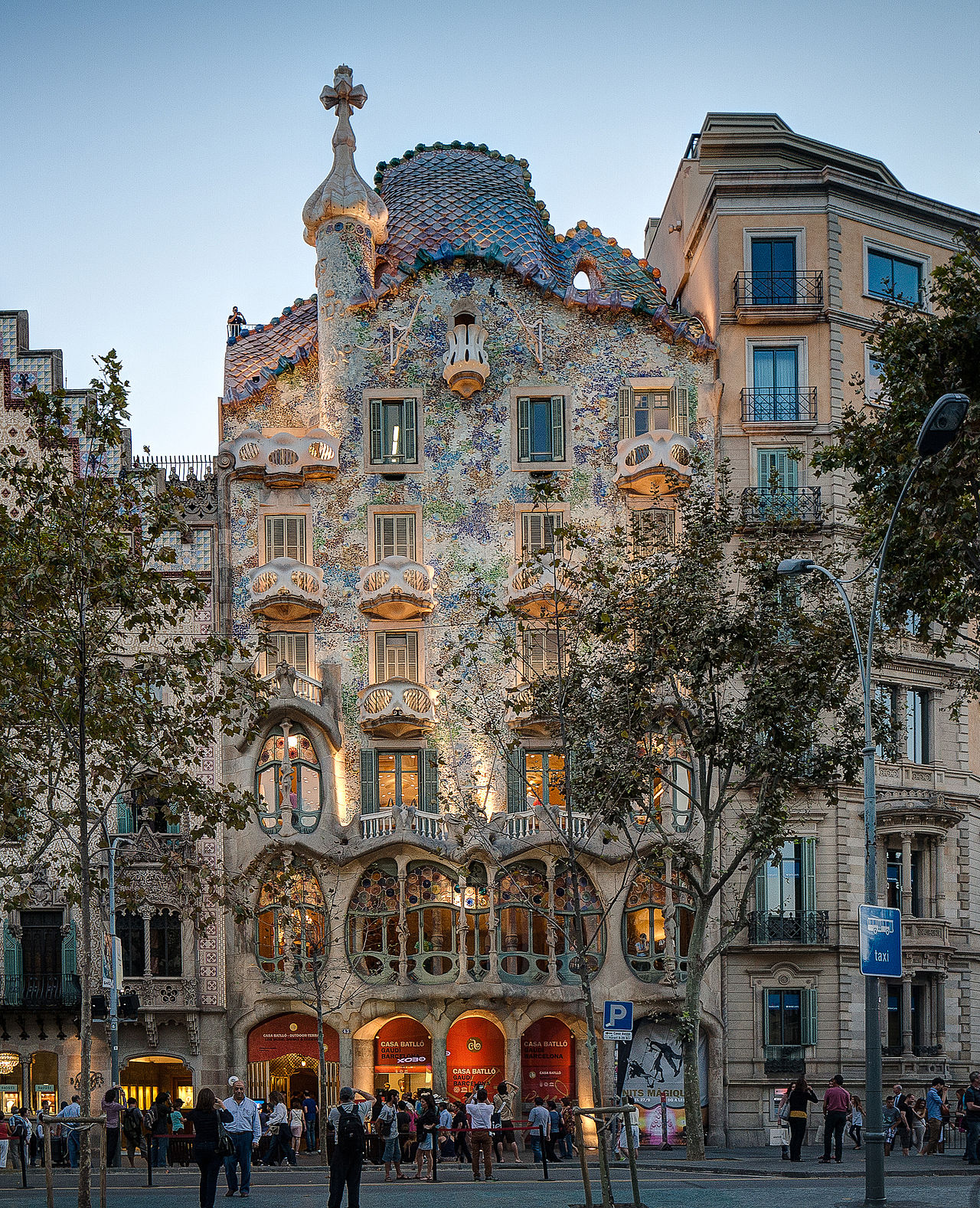
Casa Batlló (Passeig de Gràcia 43) is Gaudí’s 1904-1906 transformation of an existing 1877 building. The facade looks like it is melting — the balconies are masks (or skulls), the columns appear to be bones, the iridescent tile-mosaic facade represents the sea, and the curving rooftop covered in dragon-scale tiles is the spine of a dragon. Inside, the staircase imitates the spine of the dragon, the lightwell glows blue at the top and white at the bottom, and the chimney stacks on the roof look like medieval helmeted warriors. Entry is 35-50 euros, book online, 1.5-2 hours.
La Pedrera (Casa Milà, Passeig de Gràcia 92) is Gaudí’s 1906-1912 apartment building, his last secular work before he devoted himself entirely to Sagrada Família. The wave-like limestone facade has no straight lines and looks like a cliff carved by the sea. The rooftop — the famous one with the giant chimney stacks that look like ancient warriors — has stunning views of the city. Entry is 25-30 euros, 60-90 minutes inside, plus the rooftop. The Espai Gaudí (the attic level) holds an exhibition on Gaudí’s design philosophy and the actual catenary models he used to design the church.
Late Afternoon: Park Güell (5:30 PM – 7:30 PM)
Take a taxi or the bus 116/24 to Park Güell (Carrer d’Olot 13). The park was Gaudí’s project for industrialist Eusebi Güell, originally planned in 1900-1914 as a luxurious housing development on the hill outside the city. The development failed commercially — only two houses were built and Gaudí himself lived in one of them — and the city bought the property in 1922 to turn it into a public park.
The Monumental Zone (the part with all the famous mosaic structures) requires a 18-euro ticket and timed entry. Book online weeks ahead. The free zone of the park is fine to walk through but the famous spots (the mosaic dragon at the entrance, the colonnaded hall, the serpentine bench overlooking the city) are inside the paid zone.
Inside, the iconic features: the dragon staircase at the entrance with the mosaic salamander (everyone takes the same photo here), the Hypostyle Room (the colonnaded hall of 86 stone columns originally designed as the market for the failed development), the Greek Theatre (the giant terrace above the columns, with the famous undulating mosaic bench around its perimeter — the bench is 110 meters long, made of broken ceramic tiles in the trencadís technique that Gaudí pioneered). The views from the terrace stretch across the entire city to the Mediterranean.
The casa-museo (Gaudí’s own house, where he lived 1906-1925) is at the southern end of the park, separate ticket 5.50 euros. Small museum, his preserved bedroom and study.
Evening: Sant Antoni or Gràcia (8 PM – 11 PM)
For dinner, get out of the tourist zones and into the local neighborhoods. Sant Antoni (just west of the Raval) has emerged as Barcelona’s foodie neighborhood with serious tapas bars, natural wine bars, and a great restored market. Gràcia (north of the Eixample) is the village-within-the-city, narrow streets and small squares, full of independent restaurants and bars.
Sant Antoni: Bar La Plàtana (Carrer del Comte Borrell 110) for the natural wine and rotating tapas list. Bar Calders (Carrer del Parlament 25) for casual neighborhood vermouth and tapas. Tickets (Avinguda del Paral.lel 164) for Albert Adrià’s avant-garde tapas, around 100 euros per person, reserve months ahead.
Gràcia: Bar Bodega Quimet (Carrer de Vic 23) for traditional Catalan home cooking. El Glop (Carrer de Sant Lluís 24) for grilled meat and seafood, 30-45 euros per person. Hofmann for high-end pastry (their croissants are considered Spain’s best, 4 euros each).
Day 3: Beach, Barceloneta, and Choices
Day 3 takes you to the Mediterranean. The morning is for the beach and the historic seaside neighborhood of Barceloneta. The afternoon offers a choice: Camp Nou for football fans, Montjuic for the mountain views and museums, or further Modernist exploration.
Morning: Barceloneta and the Beach (8 AM – 11:30 AM)
Take the metro to Barceloneta Station (line 4). The Barceloneta neighborhood is the 18th-century fishermen’s quarter — a triangular grid of 250+ tiny houses (each originally 25 square meters, designed to fit four households) built between 1753 and 1755. The neighborhood is still working-class, with fishing boats still moored at the port, but is rapidly gentrifying.
Walk through Barceloneta’s narrow streets and emerge at the Platja de la Barceloneta — the historic urban beach, 422 meters long, surprisingly clean given how city-adjacent it is. Locals avoid Barceloneta beach because of tourists; for a better experience walk 10 minutes north along the waterfront to Platja del Somorrostro (slightly less crowded) or further north to Platja del Bogatell (the cleaner, less touristy beach, popular with locals, 30 minutes’ walk from Barceloneta).
If you visit in summer, swim and sunbathe — the Mediterranean water is warm (22-26°C June-September), the sand is the broad flat post-Olympic-restoration sand (the beach was almost entirely rebuilt for the 1992 Olympics).
Mid-Morning: Beachfront Lunch (11:30 AM – 1:30 PM)
For seafood with sand under your feet: Can Solé (Carrer Sant Carles 4) is the Barceloneta seafood institution since 1903, family-run, the original recipes — paella, fideuà (Catalan pasta paella), suquet (Catalan fish stew). 45-60 euros per person. El Cangrejo Loco (Moll de Gregal 29-30) for waterfront paella at the port. Kaiku (Plaça del Mar 1) for arròs del xef — the chef’s smoked rice that has become a famous Barcelona dish.
For paella specifically: order at lunch, not dinner — traditional Spanish paella is a midday meal. The traditional version takes 40 minutes to cook from order; if a restaurant has “individual paella” ready quickly, it is almost certainly not real paella. Catalan paella often uses fideuà (short broken noodles) instead of rice.
Afternoon Choice A: Montjuic (2 PM – 6 PM)
Take the cable car (Telefèric del Port) from Barceloneta tower up to Montjuic Hill — the 173-meter hill west of the city that hosted the 1929 World’s Fair and the 1992 Olympics. The mountain is dense with attractions and viewpoints.
The Fundació Joan Miró (Parc de Montjuic) is the museum dedicated to the Catalan surrealist Joan Miró (1893-1983), with 14,000 of his works including paintings, sculptures, and ceramics. The building itself, designed by Miró’s friend Josep Lluís Sert in 1975, is one of the great modernist museum spaces. 15 euros, 90 minutes.
The Castell de Montjuic (the 17th-century fortress at the top) has the best panoramic views of the city and the sea — 12 euros, allow 60 minutes. The Olympic Stadium and the Palau Sant Jordi from the 1992 Games are visible nearby. The Magic Fountain (Font Màgica) below the National Art Museum has free water-and-light shows on Friday-Saturday nights in summer (Wednesday-Sunday some seasons), 8:30 PM and 10 PM — worth catching if your timing aligns.
Afternoon Choice B: Camp Nou Tour (2 PM – 5 PM)
For football fans, the Camp Nou Experience is the FC Barcelona stadium tour. The stadium is the largest in Europe (99,354 seats) and is undergoing massive renovation that will be complete in 2026. 30-40 euros for the basic museum + stadium tour, 60-100 euros for the player tour with locker room and tunnel access. Allow 90-120 minutes. Take the metro to Palau Reial station (line 3) or Maria Cristina (line 3).
Afternoon Choice C: More Modernism or Just Wandering (2 PM – 5 PM)
If you skipped Casa Batlló or La Pedrera on Day 2, do them now. Or visit the lesser-known but excellent Modernist buildings: Palau de la Música Catalana (Carrer Palau de la Música 4-6, near Born) — Domènech i Montaner’s spectacular Art Nouveau concert hall, only accessible via guided tour (22 euros) but absolutely worth it — the inverted stained-glass dome above the auditorium is one of the most beautiful interiors in Spain. Casa Vicens (Carrer de les Carolines 24) — Gaudí’s first major commission (1883-1885), 18 euros, less touristy than Casa Batlló.
Evening: Final Dinner and Bunkers del Carmel Sunset (6 PM – 11 PM)
For the final sunset, the local secret is the Bunkers del Carmel — the abandoned Spanish Civil War anti-aircraft battery on Turo de la Rovira hill (262 meters). The bunkers were built in 1937 to defend against fascist bombing during the Civil War, were used as anti-aircraft positions through the war, and were later squatted as housing through the 1960s-70s, then abandoned. The flat concrete platforms have become Barcelona’s unofficial sunset viewpoint — 360-degree views of the entire city, the Mediterranean, the mountains.
Take a taxi or bus 24 to Turo de la Rovira. Bring a drink and a sandwich; sit on the concrete and watch the sun drop into the Mediterranean while the city lights come up. Arrive 60 minutes before sunset. The walk down can be done by foot (30 minutes downhill to the Eixample) or by taxi.
For final dinner: stay near the bunkers and walk down to Gràcia for a casual neighborhood meal, or go back to the historic center for a serious tapas crawl through Born or Sant Antoni. Or splurge: Cinc Sentits, Disfrutar, Tickets, or Lasarte (one of Spain’s only 3-star restaurants, Martín Berasategui’s Barcelona outpost, 230-euro tasting).

Where to Stay in Barcelona: Best Neighborhoods
Eixample – Best for First-Timers
The Eixample (“the extension”) is the broad 19th-century grid district with the Modernist buildings, the best shopping, the wide boulevards, and the easy walking access to most attractions. Stay in the Right Eixample (Dreta de l’Eixample, between Passeig de Gràcia and Carrer de Sicilia) for the best central location.
Find Your Barcelona Hotel
Compare prices across Booking.com, Expedia, Agoda and more in one search.
Search Barcelona Hotels →Hotel Casa Fuster (Passeig de Gràcia 132) is the elegant Modernist option — a 1908 Domènech i Montaner building, 105 rooms, classic luxury. From 320 euros per night. The rooftop terrace pool has Sagrada Família views.
Cotton House Hotel (Gran Via de les Corts Catalanes 670) for a beautiful boutique inside a 19th-century cotton merchant’s mansion. From 280 euros per night.
Praktik Vinoteca (Carrer de Balmes 51) is the trendy mid-range — wine-themed boutique hotel with tastings in the lobby. From 150 euros per night.
Gothic Quarter / Born – Atmospheric and Historic
Staying in the old city means waking up to medieval streets. The trade-off is narrow rooms (most buildings are 14th-16th century), some street noise from nightlife, and slightly more tourist crush.
Hotel DO Plaça Reial (Plaça Reial 1) directly on the iconic arcaded square — 18 rooms in a beautifully restored 19th-century building, with a rooftop pool and a restaurant by chef Carles Tejedor. From 290 euros per night.
The Mercer (Carrer dels Lledó 7) is the luxury inside the actual Roman walls — the building incorporates remnants of the 4th-century Roman ramparts. From 450 euros per night.
Barceloneta – Beach Stays
Stay near the beach if a Mediterranean swim is part of your trip. Less central but you can walk to the historic city in 20 minutes.
Hotel Arts Barcelona (Carrer de la Marina 19-21) is the iconic 44-story luxury tower at the Olympic Port, with sea views and Frank Gehry’s giant copper-mesh fish sculpture out front. From 500 euros per night.
W Barcelona (Plaça Rosa dels Vents 1) for the famous sail-shaped luxury hotel on the beach with the rooftop bar. From 400 euros per night.
Where to Eat in Barcelona
Catalan cuisine is distinct from Spanish cuisine — more vegetable-forward, more seafood-focused, more grilled, and uses techniques like the sofíto (a slow-cooked tomato-onion base) and picada (a finishing paste of nuts, garlic, and bread) that originate in the Catalan tradition. Tapas are a Madrid and Andalusian invention adopted in Barcelona, but the Catalan equivalent is the pintxos (Basque-style small bites pinned with toothpicks, common in many Barcelona bars) and the tapeo (moving from bar to bar eating standing).
Catalan Classics
Pa amb tomàquet: grilled bread rubbed with garlic and tomato, drizzled with olive oil. The most basic Catalan dish, served at every meal.
Esqueixada: shredded raw salt cod with tomato, onion, olives, and olive oil. A classic Catalan salad.
Escalivada: roasted vegetables (eggplant, red pepper, onion, tomato) served cold with olive oil. Often topped with anchovies.
Fideuà: the Catalan answer to paella, using short broken noodles instead of rice, with seafood. Toasted in the pan to develop nuttiness.
Suquet de peix: Catalan fish stew with potatoes, almonds, and white wine.
Crema catalana: the Catalan version of crème brûlée — lighter (uses milk rather than cream), often flavored with lemon and cinnamon.
Tapas Bars
Bar Pinotxo (La Boqueria market) for the classic counter experience.
Quimet i Quimet (Carrer del Poeta Cabanyes 25, Poble Sec) for the most-acclaimed standing-only tapas bar in Barcelona — the family has been here since 1914, the specialty is montaditos (open-faced small toasts with creative combinations), 3-6 euros each. Reserve nothing, arrive at 7 PM or 1 PM to get in.
Bar del Pla (Carrer de Montcada 2, Born) for modern Catalan tapas at the counter, 35-45 euros per person.
Tickets (Avinguda del Paral.lel 164) for Albert Adrià’s avant-garde tapas inspired by El Bulli, 90-120 euros per person, reserve 3-4 months ahead.
Vermouth Bars
The vermouth tradition is alive in Barcelona. Order “un vermut” and you will get red vermouth on the rocks with an orange peel and olive, with a small dish of olives or chips. 3-5 euros. Best vermouth bars: Sense Pressa, Bormuth, La Confitería (Carrer de Sant Pau 128, in a converted 1912 confectionery shop), Cal Marino (Carrer Margarit 54, Poble Sec).
High-End Catalan
Disfrutar (Villarroel 163) for the heirs of El Bulli — 3 Michelin stars, 280-euro tasting menu, reserve 3-4 months ahead. Lasarte (Calle Mallorca 259) for Martín Berasategui’s 3-star Basque-Catalan restaurant, 230 euros. Cinc Sentits for the more accessible 1-star tasting, 95-115 euros.
Getting Around Barcelona
Metro and Bus
Barcelona’s metro has 11 lines, 165 stations, and reaches almost everywhere. Buy a T-Casual ticket (12.55 euros for 10 trips, transferable between people) or a Hola Barcelona tourist card (16.40 euros for 48 hours, 23.80 for 72 hours, unlimited). Metro hours: 5 AM – 12 AM weekdays, until 2 AM Friday and Saturday. Single fare 2.65 euros.
Flights to Barcelona
Compare flight deals to Barcelona (BCN) from 100+ airlines and 1,000 agencies.
Search Flights to Barcelona →Walking
Barcelona is highly walkable. The Eixample’s wide chamfered-corner sidewalks were designed for pedestrians, and the historic center is small. From the Sagrada Família to the Cathedral is 2 km, 25 minutes on foot. The Eixample grid makes navigation straightforward — most addresses can be located without a map.
Taxis and Uber
Barcelona taxis are black-and-yellow with green roof lights when free. Meter starts at 2.30 euros, then 1.21 euros per km. Average cross-city ride 10-15 euros. Uber operates in Spain in Black/Lux tiers only (not the cheaper UberX), so usually more expensive than taxis. Cabify is the local app alternative.
Airport
Barcelona El Prat Airport is 12 km southwest. The Aerobús runs every 5-10 minutes between Plaça de Catalunya and the airport, 6.75 euros one-way, 35 minutes. Metro line L9 Sud reaches the airport with one transfer required, 5.50 euros, 40-50 minutes. Taxis are flat-rate 39 euros to the city center, 25-30 minutes.
What to Know Before You Go
Language: Catalan and Spanish
Barcelona is officially bilingual — Catalan and Spanish (Castilian) are both official languages. Most signs are in Catalan first, Spanish second. Catalan is not a dialect of Spanish; it is its own Romance language, closer in some ways to French and Italian than to Spanish. Spoken Catalan sounds distinctly different from Spanish (more nasal, with sounds like “ç” and “l·l” that don’t exist in Spanish).
Almost all Barcelonans speak both languages. Speaking Spanish is fine and expected. Speaking a few Catalan phrases (Bon dia / good morning, Hola / hi, Gràcies / thanks, Adeu / goodbye, Si us plau / please) is appreciated by locals. English is widely spoken in the tourist zones and major restaurants.
Money and Tipping
Service is included in restaurant prices by law. Tipping is optional — round up the bill, leave 1-3 euros at casual meals, 5-10 euros for a serious dinner. American-style 20% tips are excessive and unexpected. Bar tipping: round up the espresso to the nearest euro.
Credit cards work in restaurants and shops. Small bars, market stalls, and some traditional bodegas are cash-only. Carry 40-60 euros cash. ATMs are abundant; use bank-branded ones (CaixaBank, BBVA, Santander) to avoid Euronet fees.
Schedule and Meal Times
Spanish meal times shift everything later. Lunch is 1:30-3:30 PM, often the largest meal of the day. Dinner is 9-10:30 PM, often lighter (or just a tapas crawl). Many restaurants do not even open until 8 PM. Adjust your body clock or accept that you will be eating dinner with mostly tourists if you go at 7 PM.
Most shops outside the tourist center close 2-5 PM for siesta (especially in summer), then reopen until 8 PM. Sunday closures still apply to most non-tourist retail.
Safety
Barcelona is generally safe for violent crime but has Europe’s highest pickpocketing rate per capita (according to multiple recent rankings). Particularly: Las Ramblas (pickpockets target tourists watching street performers), Sagrada Família entry queues, the metro (lines 3 and 4 in particular), Barceloneta beach (“sand sleeper” thieves), and Plaça Reial at night.
Use crossbody bags worn in front, never put your phone in your back pocket, never leave anything unattended on a beach, ignore the petition scammers and the costumed characters on Las Ramblas. Wallets are sometimes returned at police stations with cash removed but cards intact; report immediately if stolen.
Best Time to Visit
April-June and September-October are the optimal months — warm weather (18-25°C), Mediterranean sea swimmable May-October, fewer crowds than July-August. July-August is hot (28-32°C peaks, beach packed, hotels expensive, many local restaurants closed). November-March is mild but rainier, with the Christmas markets in December (Fira de Santa Llucia at the Cathedral).
Common Mistakes First-Time Visitors Make
1. Not Booking Sagrada Família in Advance
Sagrada Família is Spain’s most-visited attraction. Same-day tickets sell out by 9 AM in peak season. Book online at least 2 weeks ahead, ideally 4 weeks. Same applies to Park Güell’s monumental zone, Casa Batlló, and the Picasso Museum.
2. Eating on Las Ramblas
Las Ramblas restaurants are the most-touristy in Barcelona, with paella served on plastic plates at 22 euros that costs 14 euros and is significantly better one block off. Step into any side street and prices drop, quality rises.
3. Pickpocketing
Barcelona has Europe’s highest pickpocketing rate. Wear bags crossbody in front, never put phones or wallets in back pockets, never leave anything unattended at beaches or restaurant tables. Pickpockets work in distraction teams — one bumps you, the other lifts.
4. Ordering Paella for Dinner
Traditional Spanish paella is a midday meal. Restaurants that have paella ready quickly at dinner are almost certainly using pre-cooked or frozen versions. Order paella at lunch (1:30-3 PM) for the proper experience.
5. Missing the Vermouth Hour
The 12:30-2 PM and 6-8 PM vermouth tradition is one of Barcelona’s most pleasant cultural rhythms. Many tourists skip it and miss what locals actually do between meals. Stop at a vermouth bar at least once and order vermut with a tapa.
6. Eating Dinner at 7 PM
Spanish dinner starts at 9 PM. At 7 PM, you are eating with other tourists at restaurants that have adjusted their hours. Eat lunch big, snack on tapas at 6 PM, then proper dinner at 9 PM for the authentic experience.
7. Skipping the Modernist Buildings Besides Gaudí’s
Gaudí dominates the Barcelona Modernist conversation but Domènech i Montaner (Palau de la Música Catalana, Hospital de Sant Pau, Casa Fuster) and Puig i Cadafalch (Casa Amatller, Casa de les Punxes) produced equally remarkable buildings. Add at least one non-Gaudí Modernist building to your itinerary.
Estimated Costs: 3 Days in Barcelona
Budget (650-950 euros for 2 people, 3 nights)
Accommodation: 110-160 euros per night for a 3-star hotel in Eixample or Gothic. Meals: 25-35 euros per person per day. Transport: 16 euros each for T-Casual 10-ride card. Attractions: 70-90 euros per person.
Mid-Range (1,200-1,700 euros for 2 people, 3 nights)
Accommodation: 200-280 euros per night for a 4-star boutique. Meals: 60-80 euros per person per day including one starred dinner. Attractions: 100-130 euros per person.
Luxury (2,500-5,000 euros for 2 people, 3 nights)
Accommodation: 400-800 euros per night at Hotel Arts, W Barcelona, The Mercer, or El Palace. Meals: 150-250 euros per person per day at starred restaurants.
Frequently Asked Questions
Is 3 days enough in Barcelona?
Yes, three days is enough to cover the major Gaudí sites, the Gothic Quarter, a beach afternoon, and serious tapas. Four days lets you add Montjuic or a day trip; five days is ideal for a comprehensive visit.
What is the best time to visit Barcelona?
April-June and September-October for mild Mediterranean weather and beach-swimmable temperatures. Avoid July-August (hot, crowded, expensive). November-March is mild but rainier; December has the Christmas markets.
How much does a 3-day Barcelona trip cost?
For two people: 650-950 euros budget, 1,200-1,700 euros mid-range, or 2,500+ euros luxury, including accommodation, food, transport, and major attractions. International flights extra. Barcelona is slightly cheaper than Paris, similar to Rome.
Do I need to book Sagrada Família tickets in advance?
Yes, absolutely. Sagrada Família is Spain’s most-visited monument with 4.5+ million annual visitors. Same-day tickets sell out by 9-10 AM in peak season. Book online 2-4 weeks ahead at sagradafamilia.org.
Is Catalan the main language in Barcelona?
Catalan and Spanish are both official. Most signs are in Catalan first. Locals speak both fluently. Spanish (Castilian) is fine for tourists; learning a few Catalan greetings (Bon dia, Gràcies) is appreciated. English is widely spoken in tourist zones.
Where is the best beach in Barcelona?
The famous Barceloneta beach is the closest to the city but is touristy. Bogatell beach (30 minutes’ walk north) is cleaner and popular with locals. Sant Sebastià beach is the calmest. All are urban beaches with cafes, showers, and bathroom facilities.
Is Barcelona safe?
Very safe for violent crime. Barcelona has Europe’s highest pickpocketing rate. Wear bags crossbody in front, never leave items unattended, be vigilant on Las Ramblas, in the metro, and at beaches. Tourist scams (petitions, fake police, distraction games) target visitors.
When do restaurants open for dinner in Barcelona?
Most restaurants open for dinner at 8 PM, with peak service 9-10:30 PM. Eating at 7 PM means restaurants serving only tourists; the local rhythm is later. Adjust your body clock or accept the tourist-timing.
Related Travel Guides
Final Thoughts
Three days in Barcelona is enough to genuinely fall for the city. The combination of medieval streets, Modernist architecture, Mediterranean beach, and serious food culture is rare anywhere in Europe — maybe only Lisbon comes close, and Barcelona has more of each. The architecture alone justifies the trip; the food and the beach extend it; the Catalan cultural identity gives it a texture distinct from elsewhere in Spain.
Walk slowly. Sit at vermouth bars during the day. Eat dinner at 9 PM. Skip one museum to spend an extra hour wandering the Gothic Quarter or sitting on a beach. Barcelona rewards visitors who let themselves slip into Catalan time — the slower meals, the later evenings, the relaxed Mediterranean rhythm. Three days is enough to start.
