

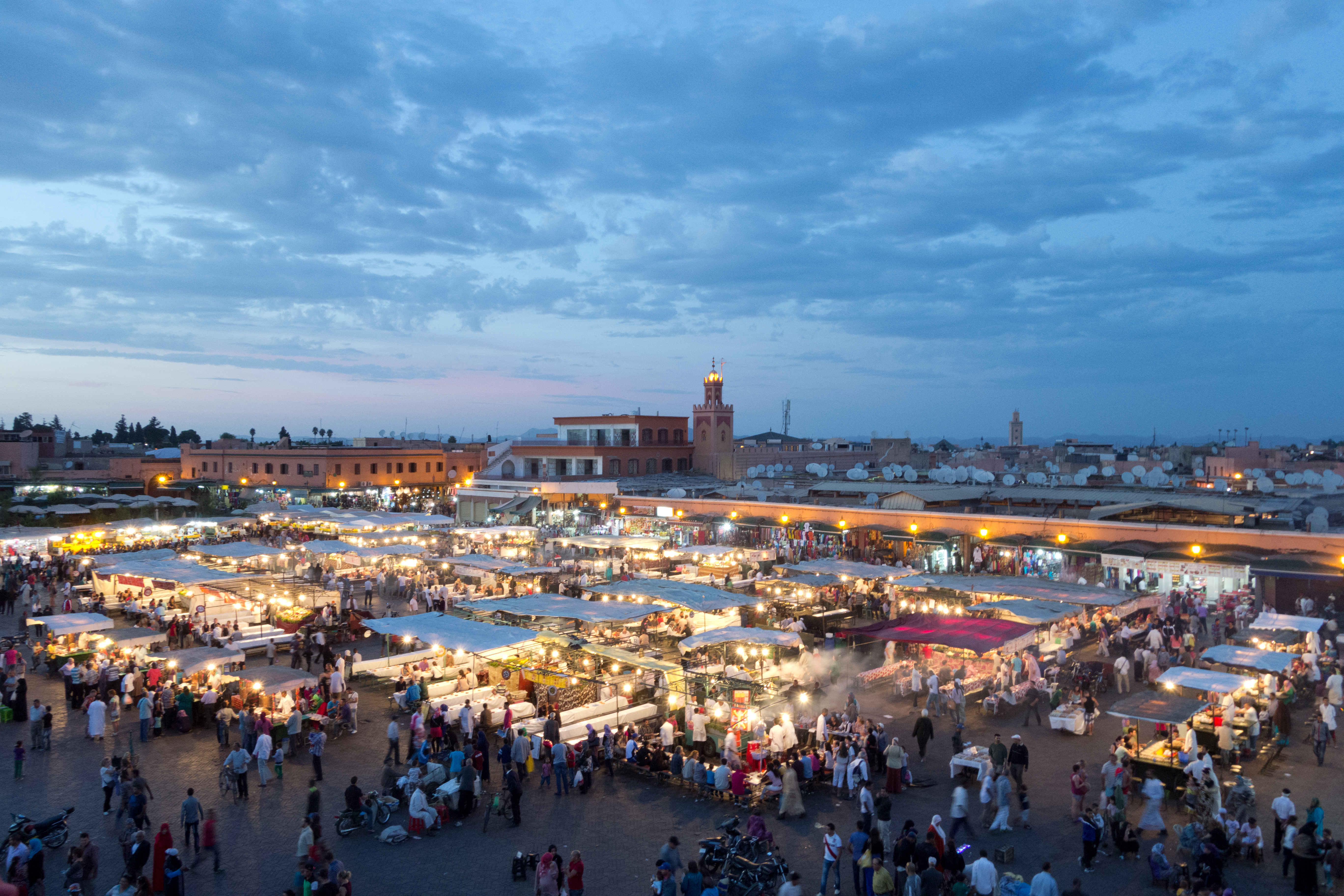
Marrakech is Moroccos imperial Red City, the 11th-century walled medina that has preserved its labyrinth of souks, riads, and 250 mosques for nearly 1,000 years. The city sits at the foot of the Atlas Mountains, between the Sahara Desert and the Atlantic Ocean, and serves as the most accessible introduction to North Africa for travelers from Europe (3-hour flight from London, Paris, or Madrid).
This itinerary covers the three Marrakeches that overlap inside three days: old Marrakech (the medina, the souks, Jemaa el-Fnaa square, the historic palaces and gardens), new Marrakech (Gueliz, the modernist district with art galleries, French cafes, and the Majorelle Garden), and Atlas Marrakech (day-trip access to the Agafay desert, Berber mountain villages, and the Ourika Valley).
Why 3 Days Works in Marrakech
Marrakechs medina is small — 4 sq km surrounded by 19 km of red sandstone walls built by the Almoravid dynasty in 1070-1071. Inside, the streets are too narrow for cars, so everything is walking distance, but the labyrinth is genuinely disorienting (Google Maps fails in the medina). Three days is enough to feel the rhythm without exhausting yourself in the heat.
Three days covers Jemaa el-Fnaa and the souks, Majorelle Garden and YSL Museum, the historic Saadian Tombs and Bahia Palace, plus an afternoon escape to Agafay Desert or Atlas Mountains. You will not have time for Essaouira coast day trip (3 hours each way), the Berber market day trips, Ouzoud Waterfalls (3 hours), Ouarzazate and Ait Ben Haddou (4 hours). With four days you add Essaouira or Ourika; with five you can do a Sahara overnight to Merzouga (long drive but unforgettable).
Day 1: The Medina and Jemaa el-Fnaa
Morning: Souks and Bahia Palace (8 AM – 12 PM)
Start before 9 AM when the heat is tolerable and the tour groups have not arrived. Enter the medina through Bab Agnaou or Bab Aganaou gates from your riad. Jemaa el-Fnaa, the main square, is calmer in the morning — the orange juice vendors at the brass carts (10-15 MAD per glass), the snake charmers and monkey handlers (avoid — they expect payment for photos), the herbalists with apothecary jars of dried herbs and spices.
Walk north into the souks. The labyrinth is organized by specialty: Souk Semmarine (textiles and slippers), Souk Cherratin (leather goods, ride the metaphorical wave of bags and jackets), Souk Haddadine (metalwork, hammered lanterns and pots), Souk des Teinturiers (dyers with cloth hanging colorful overhead). Bargain to 30-40% of asking price.
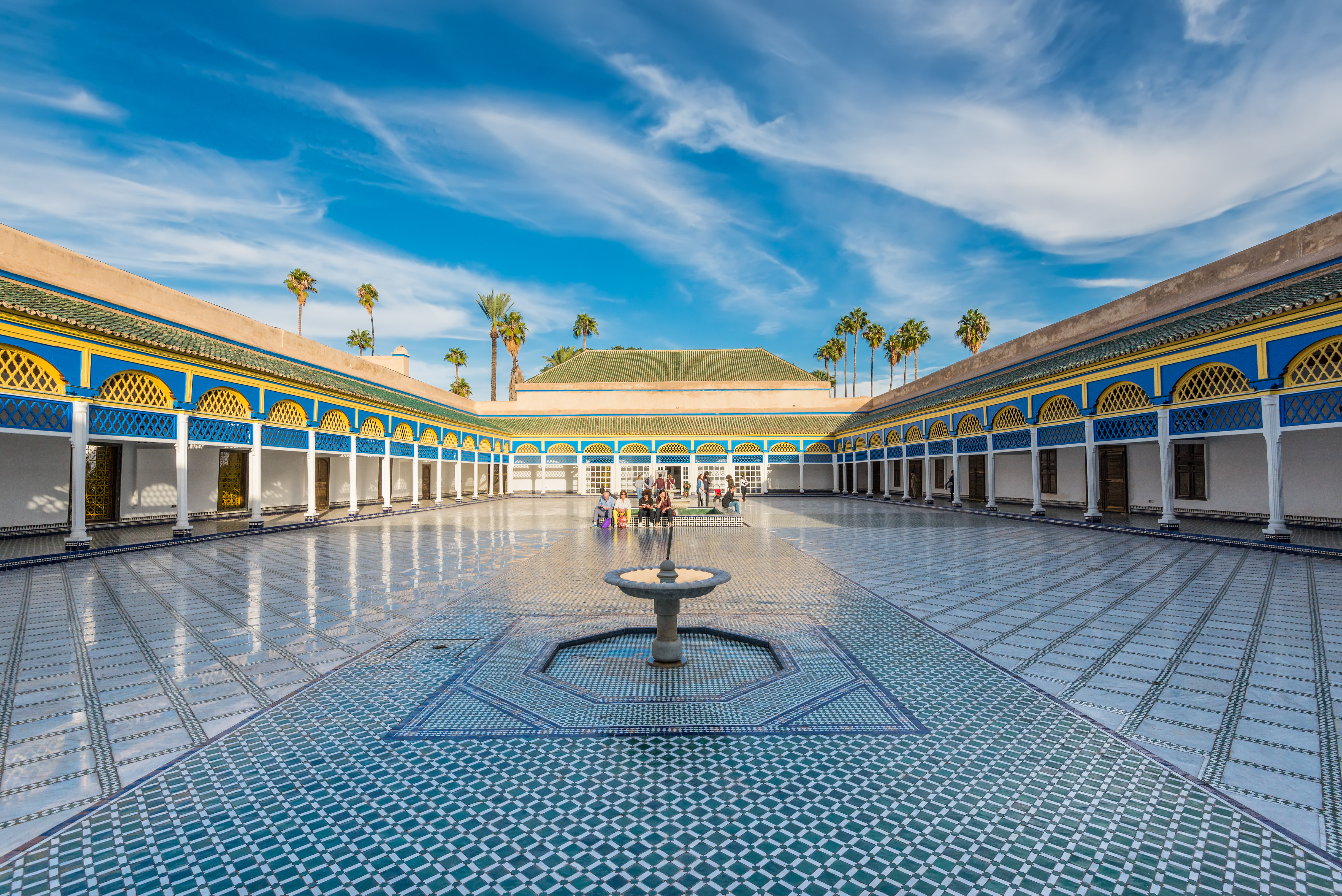
Walk south to Bahia Palace (Rue Riad Zitoun el Jdid, 70 MAD). Built 1859-1900 by Grand Vizier Bou Ahmed, the 8,000 sq m palace was meant to be the greatest of its era — 24 rooms decorated with carved cedar ceilings, painted plaster, marble courtyards, and zellige tile work. Visit takes 60-90 minutes. Continue to the adjacent El Badi Palace ruins (70 MAD, the 16th-century palace built from 360 rooms of marble and gold, now mostly ruins occupied by storks).
Lunch: Local Riad Restaurant (12 PM – 2 PM)
The medina has 500+ restaurants. Reliable: Naranj (Lebanese in a beautiful courtyard, 80-150 MAD), Cafe Arabe (rooftop with city views, Italian + Moroccan, 120-200 MAD), Nomad (modern Moroccan, rooftop, 150-250 MAD per person, book ahead). For street food: Kissariate (lamb tangia in clay pots, 60 MAD), Cafe Clock (camel burger 95 MAD).
Afternoon and Evening: Saadian Tombs, Koutoubia, and Sunset (3 PM – 10 PM)
After lunch when the heat peaks, retreat to your riad for a 2-hour rest — this is the traditional Moroccan afternoon. Return at 4 PM. Saadian Tombs (Rue de la Kasbah, 70 MAD) — the 16th-century royal necropolis with 66 graves of Saadian dynasty members, sealed by Sultan Moulay Ismail in 1672 and not rediscovered until 1917. The Hall of Twelve Pillars is the masterpiece.
Koutoubia Mosque (the 77-meter minaret, 12th century) anchors the skyline. Non-Muslims cannot enter the mosque itself but the surrounding gardens are public. The minaret is the model for the Hassan Tower of Rabat and the Giralda of Seville.
Return to Jemaa el-Fnaa at sunset — the square transforms completely. 100+ food stalls light up, performers fill every corner (storytellers, musicians, acrobats), the smoke from grilled meats hangs over the crowd. UNESCO declared the square an Intangible Cultural Heritage in 2001. Eat at the food stalls (50-100 MAD for a full meal of grilled meats, salads, bread) or take a rooftop terrace view (Cafe France, Cafe Glacier).
Day 2: Gardens, Museums and Hammam

Morning: Majorelle Garden and YSL Museum (8 AM – 12 PM)
Majorelle Garden (Avenue Yves Saint Laurent, Gueliz, 150 MAD entry) was created by French painter Jacques Majorelle starting in 1923. Yves Saint Laurent and Pierre Berge bought it in 1980 and restored it. The garden contains 300 plant species from 5 continents, the iconic cobalt-blue villa (“Majorelle Blue”), and the Berber Museum (free with entry).
The YSL Museum Marrakech next door (100 MAD) opened 2017 and houses 5,000 garments and 15,000 accessories from Saint Laurents 40-year career. Le Jardin Secret nearby (Rue Mouassine, 80 MAD) is an Islamic garden restored in 2008 with two parts: the Exotic Garden and the larger Islamic Garden (the largest paradise garden in Marrakech).
Lunch and Hammam (12 PM – 4 PM)
Lunch at Cafe Mahn-aa in Majorelle area or back to medina for tagine. Then experience a traditional hammam. Three options: Royal hammam at La Mamounia (1,500-2,500 MAD for the full ritual, used by Churchill and many world leaders), Les Bains de Marrakech (400-800 MAD, full ritual, 1.5-2 hours), or a local public hammam (30 MAD entry plus 50-100 MAD for scrub, gender-segregated, very local experience). The traditional ritual: black olive-oil soap rub-down (savon noir), red argan exfoliation gloves (kessa), rhassoul clay mask, hot mineral water rinse.
Evening: Ben Youssef Madrasa and Riad Dinner (4 PM – 10 PM)
Ben Youssef Madrasa (50 MAD), the 14th-century Islamic school recently restored 2020. Once the largest madrasa in North Africa, with 130 student cells and a magnificent central courtyard of zellige tile, marble, and carved cedar. Allow 60-90 minutes. The recently-reopened Marrakech Museum next door is in the Dar Menebhi Palace.
Evening dinner in a riad: Le Tobsil (set menu 700 MAD, 7 courses with traditional Andalusian musicians), La Maison Arabe (their cooking class includes dinner), Dar Yacout (the original Moroccan banquet experience, 700 MAD). For modern: Plus 61 (Aussie-Moroccan fusion, 350-450 MAD).
Day 3: Agafay Desert or Atlas Mountains Day Trip

For your final full day, escape the medina chaos with a desert or mountain experience. Both are roughly an hour from Marrakech and offer dramatically different landscapes.
Option A: Agafay Desert (Rocky Desert)
Despite the name, Agafay is not the Sahara. It is a rocky, lunar-like stone desert 45 minutes southwest of Marrakech with the snow-capped Atlas Mountains as a backdrop. Half-day tours run 500-800 MAD per person and typically include camel rides, quad biking, and a traditional Berber lunch in a Bedouin-style camp.
For something more memorable, book a sunset dinner experience at Agafay Luxury Camp or Inara Camp (1,500-2,500 MAD per person) which includes a three-course Moroccan dinner, live Gnawa music, and overnight glamping in luxury tents with private bathrooms.
Option B: Atlas Mountains and Ourika Valley
The Atlas Mountains rise dramatically just south of Marrakech and offer cooler temperatures, Berber villages, and waterfalls. The Ourika Valley is the most popular day trip, with seven cascading waterfalls (a 90-minute moderate hike), traditional Berber villages, and roadside argan oil cooperatives where you can see women extracting oil by hand.
For serious hikers, continue to Imlil at the foot of Mount Toubkal (4,167 m, North Africa’s highest peak). Multi-day Toubkal summits require a certified guide and basic mountaineering gear. Group day tours from Marrakech run 250-450 MAD including transport and lunch in a Berber home. Private 4×4 with driver: 1,200-1,800 MAD.
Option C: Essaouira Coast (Alternative)
If you have already visited deserts elsewhere, swap day 3 for Essaouira, a relaxed Atlantic fishing port and former Portuguese stronghold 2.5 hours west. UNESCO-listed medina, fresh grilled sardines on the port, windswept ramparts. Group tours 300-500 MAD.
Where to Stay in Marrakech

Marrakech accommodation falls into two distinct categories: traditional riads inside the medina walls (intimate courtyard guesthouses), and modern hotels in the Gueliz or Hivernage districts.
Medina Riads (Most Atmospheric)
A riad is a traditional Moroccan house built around a central courtyard, often with a fountain, citrus tree, and rooftop terrace. Sleeping in a riad is the quintessential Marrakech experience. Expect 5-15 rooms, breakfast included, and intimate service. Downsides: medina streets are narrow, taxis cannot reach most riads, and arrival requires a porter with a cart. Range: 600-2,500 MAD per night.
Top picks: Riad Yasmine (Instagram-famous green pool), Riad BE Marrakech, El Fenn (Vanessa Branson’s art-filled boutique), La Sultana (luxury with hammam).
Gueliz (Modern New City)
The French-built new city, 10 minutes by taxi from Jemaa el-Fnaa. Wide boulevards, modern hotels with pools and gyms, easier arrivals. Best for first-time visitors who prefer Western-style comforts. 800-1,800 MAD per night. Recommended: Radisson Blu Carre Eden, 2Ciels Boutique Hotel.
Hivernage (Luxury District)
Upscale area between the medina and Gueliz with the city’s grandest 5-star hotels. La Mamounia (the legendary palace hotel, 3,500+ MAD), Royal Mansour (royally owned, 8,000+ MAD), Four Seasons.
Palmeraie (Resort Style)
20 minutes outside the city in a palm grove. Sprawling resorts with full grounds and golf courses. Best for resort relaxation, not city exploration. Murano Resort, Es Saadi Palace.
Budget Options
Equity Point Marrakech (hostel from 150 MAD/dorm), Riad Dia (90 USD/night double), Hotel Toulousain in Gueliz (350 MAD/night).
Where to Eat in Marrakech
Moroccan cuisine in Marrakech revolves around tagines (slow-cooked stews in conical clay pots), couscous (served traditionally on Fridays), pastilla (a savory-sweet pigeon or chicken pie), and harira (lentil-tomato soup, especially during Ramadan). Mint tea (the-a-la-menthe) is ceremonial and offered everywhere.
Traditional Moroccan
Le Tobsil (medina, 650 MAD set menu, reservations essential), Le Foundouk (medina rooftop, 400-600 MAD), Dar Yacout (theatrical 7-course feast in a riad, 800 MAD), La Maison Arabe (cooking school by day, restaurant by night, 500 MAD).
Street Food and Casual
Jemaa el-Fnaa night stalls (40-80 MAD per dish, stall #14 is widely recommended for grilled meats), Mechoui Alley off the souks (slow-roasted lamb shoulder, 80 MAD per kilo), Cafe Clock (camel burger, 90 MAD, also offers cultural events).
Modern and Fusion
Nomad (medina rooftop, modern Moroccan, 200-350 MAD), +61 (Australian-Moroccan fusion in Gueliz, 250-400 MAD), Plus 61 (sister property), La Famille (vegetarian garden cafe, 150-250 MAD), Cafe des Epices (medina rooftop with views, 80-150 MAD lunches).
Coffee, Pastries, Drinks
Bacha Coffee (gorgeous setting inside Dar el Bacha museum, 50-90 MAD), Le Jardin Secret cafe, Patisserie des Princes (medina, classic gazelle horn cookies). Alcohol is restricted in the medina: most riads do not serve it, but Gueliz restaurants and hotel bars do. Try Moroccan wine from Meknes region.
Getting Around Marrakech
Walking
Inside the medina, walking is the only option as the lanes are too narrow for cars. Carry a paper map or downloaded Google Maps offline area; GPS works poorly because some lanes are not mapped. Wear closed shoes (donkey droppings, uneven cobbles).
Petit Taxis
Beige or cream small taxis. Insist on the meter (compteur) or agree on a price before getting in. Medina to Gueliz: 20-30 MAD. Medina to airport: 100-150 MAD by day, 150 MAD by night. Tourists are routinely overcharged; agree on the fare in advance.
Careem and inDrive
Uber does not operate in Marrakech but Careem and inDrive work well. Careem from medina to Majorelle Garden costs about 25 MAD versus 50-70 MAD by petit taxi. inDrive lets you negotiate the fare directly with drivers.
Horse Carriages (Caleches)
Touristy but pleasant for an hour ride around the ramparts at sunset. 200-300 MAD per hour negotiated. Find them lined up at Jemaa el-Fnaa.
What to Know Before You Go to Marrakech
Best Time to Visit
March-May and September-November are ideal: pleasant 20-28C, manageable crowds. December-February is mild (15-20C, cool evenings) and cheaper. June-August is brutally hot (40C+ daily), book a pool, plan early morning and late evening activities.
Currency and Tipping
The Moroccan Dirham (MAD) is a closed currency: you cannot get it before arriving. ATMs are widely available at the airport and in Gueliz. 1 EUR is roughly 11 MAD, 1 USD is roughly 10 MAD as of 2026. Tip restaurant staff 10%, taxi drivers round up, hotel porters 10-20 MAD, riad cleaning staff 50-100 MAD for the stay.
Dress Code
Marrakech is liberal compared to other Moroccan cities but it remains a Muslim country. Women should cover shoulders and knees in the medina and inside mosques (foreigners cannot enter mosques anyway, except Tin Mal). Skip short shorts. At resort pools and Gueliz, swimwear and Western dress are fine.
Language
Arabic and Berber are official; French is widely spoken in business and tourism; English works in hotels and major restaurants but less in souks. Learn three phrases: salam aleikum (hello), shukran (thank you), la shukran (no thank you, essential for declining vendors).
Bargaining
Expected in the souks. Start at 30-40% of asking price, settle around 50%. Smile, walk away if needed, never start bargaining if you do not intend to buy. Fixed-price shops exist for those who hate haggling.
Safety
Marrakech is safe but pickpocketing happens in crowds. Watch your phone in Jemaa el-Fnaa. Solo women may experience persistent attention; wear sunglasses, walk confidently, say la shukran firmly. Henna ladies and snake charmers will demand money for photos: 20-50 MAD is fair.
Common Mistakes First-Time Visitors Make
Booking a hotel outside the medina and missing the magic: while Gueliz is comfortable, you will be in taxis constantly. Stay at least one night in a riad.
Following a self-appointed guide: kids and young men in the souks offer to take you to your riad. Most lead you to shops where they get a commission. Politely decline; use Google Maps or ask shopkeepers.
Wearing brand-new white sneakers: medina lanes are dusty, splattered with mint tea, and shared with mules. Wear shoes you do not mind getting dirty.
Drinking tap water: stick to bottled water (5 MAD/1.5L) including for brushing teeth. Even locals do not drink it.
Skipping Jemaa el-Fnaa at night: the square transforms after sunset into the world’s most extraordinary open-air food and entertainment scene. Even if you ate dinner, go for fresh orange juice (4 MAD) and the atmosphere.
Cost Estimate: 3 Days in Marrakech (per person)
Budget (250-400 MAD/day, ~25-40 USD)
Dorm hostel or budget riad share, street food and Jemaa stalls, walking + occasional petit taxis, free or cheap attractions. Total: 800-1,200 MAD (80-120 USD).
Mid-Range (700-1,200 MAD/day, ~70-120 USD)
Charming riad with breakfast, three meals at mid-tier restaurants, Careem rides, museum and garden tickets, one day trip. Total: 2,500-4,000 MAD (250-400 USD).
Luxury (2,500+ MAD/day, ~250+ USD)
5-star riad or La Mamounia, fine dining at Le Tobsil and Dar Yacout, private 4×4 day trip, luxury hammam at Mamounia spa. Total: 8,000-20,000 MAD (800-2,000 USD).
Flights: vary widely. Paris-Marrakech 80-250 EUR roundtrip on Ryanair, easyJet, or Royal Air Maroc. New York-Marrakech via Casablanca 500-900 USD.
Frequently Asked Questions
Is 3 days enough for Marrakech?
Three days hits the city’s essentials and includes one Atlas or desert day trip. Four to five days lets you add Essaouira, more hammam time, and a relaxed riad pool afternoon. Two days is rushed and skips the desert.
Is Marrakech safe for solo female travelers?
Yes, with sensible precautions. Stick to busy streets after dark, dress modestly in the medina, ignore unwanted attention without engaging, stay at a reputable riad. Many solo women travel Marrakech with no issues.
What is the best month to visit Marrakech?
April, May, October, and November offer 22-28C, blue skies, and minimal rain. March is also pleasant. Avoid July-August (40C+) unless you can pool-hop all day.
Do I need cash in Marrakech?
Yes, more than most cities. Souks, petit taxis, hammams, and street food are cash-only. Restaurants and riads accept cards but often charge a 3% surcharge. Withdraw 1,500-2,500 MAD per person at the airport ATM on arrival.
How much should I tip in Marrakech?
Restaurants: 10% if not included. Taxis: round up. Hotel porters: 10-20 MAD. Riad cleaning staff: 50-100 MAD per stay envelope. Tour guides: 100-200 MAD per day. Hammam attendants: 50-100 MAD.
Can I drink alcohol in Marrakech?
Yes, in licensed restaurants, hotels, and bars (mostly Gueliz and Hivernage). Most riads do not serve alcohol unless they have a license; some allow you to bring your own. Buy at Carrefour or specialty shops; no public drinking.
What should I pack for Marrakech?
Lightweight breathable clothes covering shoulders and knees; a scarf (women) or long-sleeve shirt for mosque areas; closed walking shoes; sunglasses and sunscreen (sun is fierce year-round); a daypack for souk purchases; modest swimwear for hammam and pools.
Should I book a guide for the souks?
For the first day, yes. A licensed guide (300-500 MAD for 4 hours, book through your riad) explains the souk structure, takes you to authentic artisans (not commission shops), and bargains for you. Day 2 and 3 you can confidently explore alone.
Can I visit mosques in Marrakech?
Non-Muslims cannot enter active mosques in Morocco. You can admire the exterior of Koutoubia Mosque. The Tin Mal Mosque in the Atlas (12th century, ruined) and Hassan II Mosque in Casablanca are exceptions open to all.
Final Thoughts
Marrakech rewards visitors who lean into the chaos. Get lost in the souks, drink mint tea on a riad rooftop at golden hour, eat a tagine cooked five hours in a sealed clay pot, and finish in the desert under stars. Three days gives you the city plus a glimpse of the Atlas or Sahara, the perfect introduction to Morocco that will pull you back for a longer trip.